We are a receding generation of Vietnam Veterans, as our numbers continue to diminish over time remember these few words from the Bard, William Shakespeare who wrote:
“We few, we happy few, we band of brothers.
For he today that sheds his blood with me
Shall be my brother; but he ne’er so vile,
This day shall gentle his condition.
And gentlemen in England now abed
Shall think themselves accursed they were not here,
And hold their manhood’ cheap while any speaks
That fought with us upon Saint Crispin’s day.”
Henry V, (Act 4, Scene 3)”
Welcome Home Brothers and Sisters – we are that generation!
Today I had promised that we would talk about exotic beverages.
Of course I discussed tea in my last blog. Tea was a very important part of the daily rituals in all of Vietnam. While I never became a connoisseur of tea, I did appreciate the value that my counterparts put on this drink. In the Chinese tradition it was not only a social beverage, but it was also a medicinal brew as well. When I was badly injured and laying in the hospital in Saigon my counterpart sent me a special tea that had curative properties for back injuries. It never seemed to work its miracles on me, but I did appreciate the fullness of my counterpart’s concern and attempt to alleviate my pain.
When I came down with a mild case of malaria my counterpart sent some special tea that was supposed to cure the disease. It tasted a little bit like quinine, but I was using modern medicine, so I don’t know which actually worked the best.
Alcoholic drinks in Vietnam were unique in themselves. Let’s talk a little bit about beer.
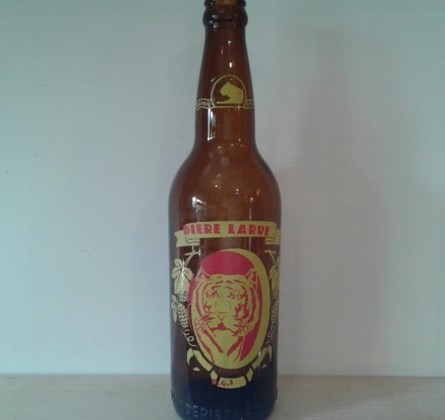
Perhaps one of the most well-known beers from Vietnam for most Vietnamese soldiers and Americans who served there was “Beer-33” or “Ba mươi ba”. Tiger Beer (Biere Larue) was also a local favorite for a lot of GIs. Both were locally available in the markets in almost every town or village where we were stationed. Some of the more entrepreneurial children would find foam containers fill them with ice and beer and they would actually go out into the field and try to sell beer to the troops. I can remember I was on one mission in the western part of our district, and we were trying to locate a Việt Cộng position where they had been hiding during their infiltrations. We were about 10 kilometers away from the village in a relatively secure ambush position and all of the sudden two young boys came down the trail lugging their Styrofoam containers of beer. Of course, our Vietnamese commander was very upset, he chewed the boys out, and sent them home. But I did notice that there was less jingling of bottles in there containers when they left. I have no idea how much beer that the soldiers actually bought from them.
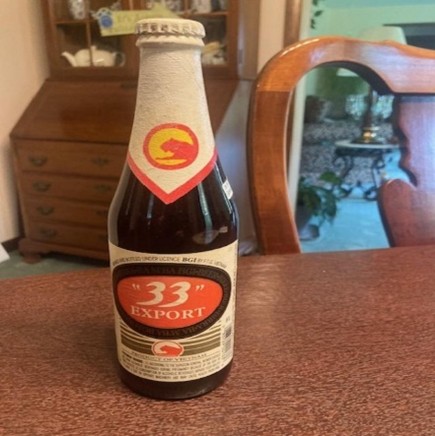
“Ba mươi ba” or Beer-33 was originally introduced by the French during their colonial rule. The name beer 33 actually comes from a French term that indicated the number 33-centilitre or 11.7 ounces of beer in the bottle. While most of the American beers that we were drinking in Vietnam were rated at 3.2% alcohol, Ba mươi ba was aheavier beer at 5.3% alcohol.
Biere Larue, or as we called it “Tiger Piss” was another very good Vietnamese beer. Again it was locally available in most of the stores in the villages and towns. Rumor had it that they killed the fermentation process with formaldehyde but in some of my readings that I have done I’ve discovered that that’s probably just a rumor. The beer did have a green tinge to it, and I think that’s what started the formaldehyde comments. Most of my counterparts preferred Biere Larue. I think they felt that since it had a French title to it, it was a more sophisticated beer to drink.
And then there were the rice whiskies. Most of it was locally brewed in makeshift stills. Some of it wasn’t that bad to drink. Unfortunately, there was some of it that tasted terrible. And it became a sign of manhood to be able to drink a lot of whiskey. Unfortunately for the Vietnamese they didn’t tolerate alcohol very well. Three drinks and they were out of it.
One exotic that I had to drink on a couple of occasions was called snake whiskey. In a way it was rather cruel to watch it be made. But it was a tradition in the villages and as an advisor you had to respect those traditions. The Vietnamese would take a large container, usually made of glass with a lid. These containers would hold maybe 3 gallons of whiskey. They would then take a scorpion and put it in the container and close the lid, they would capture a small cobra and throw it into the container as well. They would then bet on how long it would take the cobra to kill the scorpion or how many times the scorpion stung the cobra.
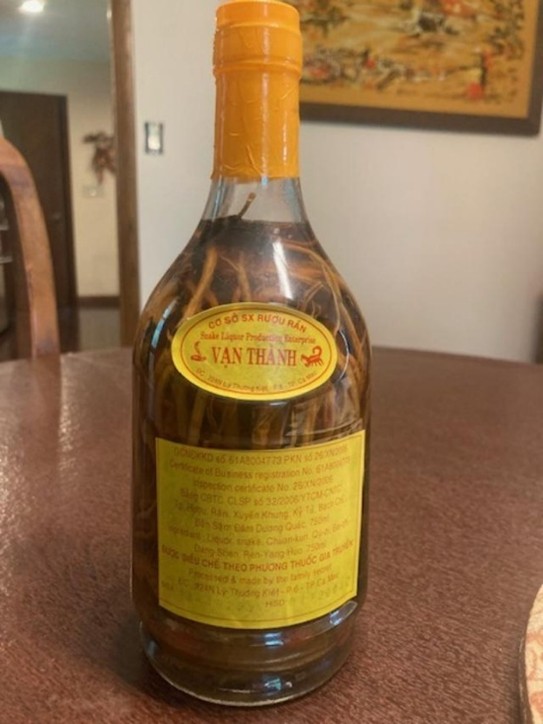
When the fight was over, they would then fill the container with whiskey and cover the container until the cobra was dead. In some cases, they would even bet on how long the cobra would survive in the whiskey. You can probably tell by now the Vietnamese would bet on just about anything.
Once the cobra was dead, they would then add some spices to the container. I think each village had its own array of spices and medicinal plants that they would add. I do know that in each village where I had this snake whiskey the flavor was always a little different. I asked my medics about consuming snake whiskey, and they said that according to the medical journals the alcohol killed any of the effects from the venom that might be there. Of course they will always emphasize ‘might be’. For the Vietnamese snake whiskey was a cure all.

Because of the alcohol content they would only drink a shot glass of it at a time, unless you got involved in a drinking party. At that point nobody left sober.
The local whiskey was called, and I know this is not the correct Vietnamese spelling, ‘bas si day’ it was a terrible tasting whiskey. It tasted like a cross between kerosene and bathtub gin. It almost had an oily taste to it. But it was the local village brew.
My Sergeant and I had to go down to this little village and take care of a very serious issue dealing with a case of old French dynamite that had been left over from the French Indochina war. After we successfully removed this ancient case of dynamite with nitroglycerin literally leaking through the box, we were considered to be local heroes. We were ready to go back to the team house, but the old village chief, who was an alcoholic, said we had to stay and have a ceremonial dinner in honor of our heroic actions.
The ceremonial meal was actually very good. We had a wide variety of different dishes, of course the always present brown rice, and a variety of vegetables and of course a lot of rice whiskey. Notice that I said brown rice. A lot of the locals preferred brown rice to white rice. It actually was better for them. The white rice was sold in the market. As I understand it the brown rice contains some additional food value to it that isn’t present in the white rice.
After the dinner the toasting and the drinking began. I sat next to the old village chief and every time that my little glass (like a shot glass) would get empty he would pour me another shot. He would then stand up and say “Một trăm”, or 100%. He would then drink the entire glass, and I was expected to do the same.
My Sergeant got a good kick out of it after the second glass he just sat back and watched the show. The Village Chief would fill my glass and say “Một trăm” and he and I would down another glass together. I have no idea how long this went on, but I was told that Sarge had to carry me back to the boat to get me back to the team house.
When I got back to the team house I staggered in and fell into the bed and laid there for about two days. The district senior advisor was not very happy with me, but at dinner one evening after I had sobered up our district chief said that the villagers thought that I was a real tough guy. I could drink with the village chief and evidently I drank him under the table. It said that no one had ever done that before. Of course I don’t remember any of it.
In 1971 when I got kicked out of Vietnam our province senior advisor was visiting the same village. CORDS had provided the village with a new tractor and there was a big dedication ceremony. The old village chief asked our Colonel where Trung úy Taylor was? He explained that I was on my way back to the United States that I had been reassigned. The old village chief laughed and said that he hoped that I would have a good trip home, but he was glad I wasn’t here. He said there wasn’t enough whiskey in the village for the two of us. Many years after this happened, I happened to be at Fort Leavenworth KS on temporary duty and my former commander was now the Garrison commander for the installation there. I ran into him at a meeting, and we had supper together a few times and he told me this story about what had happened in the village after I left.
There were a lot of other exotic drinks we had over there especially if you were working with the Montagnard, or with the Cambodians. Each group had their own specific specialties and I’m sure that a lot of soldiers had a lot of unusual drinks in the field and in the villages. There were also a lot of local varieties of rice and fruit wines and various kinds of whiskies that were locally available. In Saigon you could order just about anything from any place in the world. I could get good American liquors in some of the stores in Saigon that were imported from around the world. My district senior adviser happened to like a very specific American bourbon, and I could get it there for him.
We did a lot of drinking in Vietnam, probably much more than we should have. A lot of it dealt with boredom, in my case a lot of it dealt with dealing with the Vietnamese and just the way they handled their culture. For a 20 year old kid it was a definite experience.
When I first got to Vietnam, I was too young to drink. The first ration card that I received in Saigon had all of the hard liquor scratched out so I couldn’t buy any liquor from the post exchange system in Vietnam. From what I had been told a Christian women’s group had been visiting Vietnam and saw a lot of very young soldiers intoxicated. They went to General Westmoreland and complained. As a result, you had to be 21 years old in order to buy hard liquor in the exchange system. In the field I don’t think anybody really followed that restriction. I know that on the small PX that we had at our province advisory team, my sergeants didn’t care if I bought hard liquor or not. They felt that anybody who could go to Vietnam and fight could drink anything that they wanted to.
If you’re enjoying these blogs please drop me a comment or if you have any questions that I might answer, again submit a comment on the comment pages. I’m always glad to hear from you.
Again, please take a look at all of my books that I have listed. They can be purchased from Amazon.com with the click of a button directly from the website. Until Friday, Have a good one.
The Advisor Series:
- “The Advisor, Kien Bing, South Vietnam, 1969-1970. A Novel” (Available on Amazon ASIN: B09L4X5NQ3)
- “The Province Senior Intelligence Advisor, Kien Song Province 1970-1971; A Novel” (Available on Amazon ASIN: B0BHL2XCX5)
- “The Hardchargers,” Vietnam 1972-1973; A Novel” (Available on Amazon ASIN: B0C7SPR1JY)
- “The Tuscarora Trail”(Available on Amazon ASIN: B0D3QY2GM6)
Check out my website for other books that I’ve written or edited.
For more information visit my website: ptaylorvietnamadvisor.com


 Peter A. Taylor's Home Page
Leave a reply to Patrick Taylor Cancel reply