Black market activities posed major difficulties for American and South Vietnamese authorities during the Vietnam War. The massive arrival of U.S. military supplies, consumer goods, and US currency sparked an enormous underground economy. Items meant for American troops—like cigarettes, alcohol, clothing, and electronics—were frequently redirected and sold illegally, sometimes with help from corrupt officials or soldiers. This black market commerce disrupted official supply systems and led to inflation and shortages for Vietnamese merchants and civilians.
Black marketeers trafficked in stolen military equipment, fuel, and food. Some goods actually reached both North Vietnamese Army and Việt Cộng troops. The enormity of black market networks revealed weaknesses in logistical oversight and challenged those trying to maintain effective economic control within the war zone. Regulatory measures and investigative initiatives were designed to suppress such activities. Black marketing continued throughout the war and affected both military operations and the civilian economy.
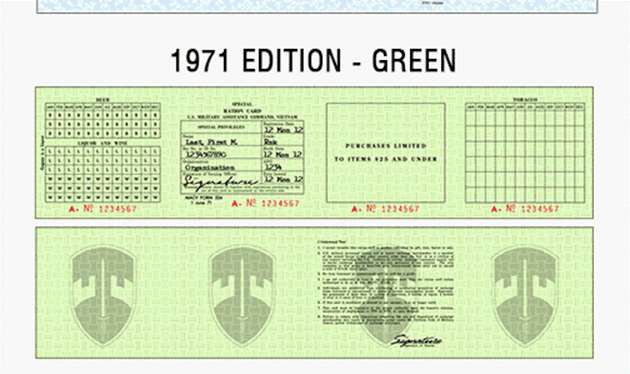
Example of MACV Ration Card for soldiers
MACV ration cards were issued to U.S. soldiers in Vietnam to regulate access to certain goods and supplies, such as beer and liquor, cigarettes, electronics such as stereos, watches, cameras and other goods that could be sold on the black market. Their primary purpose was to prevent unauthorized purchases and limit opportunities for black marketeering by ensuring that only eligible personnel could obtain these items. By tracking and controlling distribution, the cards helped authorities enforce inventory management and reduce diversion of resources intended for military use.
Soldiers were limited to purchasing limited quantities of these items. But there were some limitations. Since I was under 21 when I first arrived in Vietnam the ‘hard liquor’ portion of my card was crossed off. Although that didn’t stop most of us from purchasing liquor without a ration card.
To combat black marketing in Vietnam, authorities enforced tighter inventory controls, stricter distribution protocols, increased audits, set up checkpoints, and mandated comprehensive documentation for goods movement. Investigative units collaborated with local law enforcement to dismantle illegal networks. Despite these efforts, corruption and a complex conflict environment posed ongoing challenges.
One unique feature of the wartime economy in Vietnam was the introduction of Military Payment Certificates (MPCs) by American forces. These certificates functioned as a special currency given to U.S. military members, designed to limit black market dealings and prevent smuggling of regular currency. Unlike standard U.S. dollars, MPCs had no value outside military bases and were frequently replaced with new versions to deter stockpiling and illegal exchanges. Nevertheless, MPCs often found their way into underground markets, where they were traded for Vietnamese piasters or various goods, sustaining illicit economic activity. The routine “conversion days,” when old MPCs were swapped out for new ones, were intended to make hoarded notes worthless and interrupt unauthorized trading, but those operating on the black market continually devised methods to circumvent these restrictions.
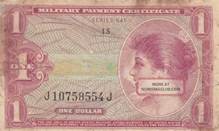
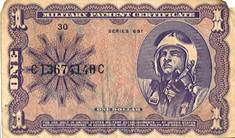
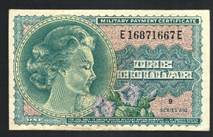
Three examples of One Dollar Military Payment Certificates used during the War
In addition to Military Payment Certificates, U.S. dollars became a highly valued asset on the black market during the Vietnam War. The stability and international acceptance of American currency made it a preferred alternative to the local piaster among Vietnamese civilians as well as illicit traders. Although regulations prohibited non-military personnel from using or possessing U.S. dollars, substantial amounts circulated within the black market through theft, bribery, and unofficial transactions.
The illicit trade of U.S. currency enabled access to restricted goods and contributed to corruption across multiple levels, thereby weakening both the local economy and U.S. initiatives aimed at regulating resource flows. Despite regular enforcement actions and the introduction of more stringent controls by authorities, sustained demand for American dollars ensured that black market activities involving the currency persisted as a considerable challenge during the conflict.
Even at some of the lowest levels of command we had issues with black marketeering. I can remember a merchant that we had in town who sold liquor. It was interesting in the fact that he could get American liquor when it was not available in the PX or Class 6 Store. If we couldn’t get into Saigon, primarily during the monsoons, we could always go to his store and get a bottle of Jim Beam or whatever else we wanted. However he always wanted us to purchase it in American MPC. He wouldn’t take our Vietnamese piastres. His daughter was a student in Saigon and she could somehow use MPC there while he was limited to trading MPC for liquor to sell at premium prices.
As mentioned above one of the difficulties that the Vietnamese had was occasional currency exchanges. On a recurring basis the U.S. military would change the design of the currency and we would have to exchange all of our old money for new money. As you can see in some of the pictures above each new bill was totally different from the one that was previously used. A paymaster would come down to our team and we would make a direct exchange dollar for dollar. For some reason the Vietnamese merchants always seem to know exactly when that was going to happen and they would flood us with requests to purchase their old money. The minute that the exchange was made their money was worthless. I can remember the first time I was at Ap Bac and we went through one of these exchanges. There were five or six local merchants who walked into the compound asking to talk to us and trying to get us to purchase their old money for as low as fifty cents on the dollar. Our Captain was very intent on not supporting the black market and therefore we never engage in any of these illegal exchanges.
Vietnamese merchants really wanted United States greenback currency. However soldiers in Vietnam were not authorized to have US money in their possession. We were paid with, and expected to use, only MPC or Vietnamese piastres in making our purchases. MPC could only be used on US bases and facilities. However, many Vietnamese merchants through the black market had ways of exchanging MPC or US dollars for Vietnamese currency.
In American dollars, the official currency exchange rate, if I remember when I was there, was 117 piasters equaled one U.S. MPC dollar. If I had a U.S. Dollar bill I could actually get about 125 piastres per dollar. This rate increased with the value of an American dollar. An American $100 bill could be exchanged for between 300 and 375 piasters per dollar. If I had a U.S. $100 dollar bill in my pocket, which I never did, I could exchange it on the black market for more than 30,000 piaster. If I took that amount of piaster to someplace where I could legally exchange it my $100 bill would be worth over $250. There were ways of doing that if one understood how the black market worked and where unscrupulous money changers were located. Some soldiers managed to establish bank accounts in Vietnam where they would make these exchanges. They would then transfer the money home using traveler check, bank drafts or direct transfers of their funds to their accounts in the United states. While this was an illegal operation some unscrupulous bankers were happy to help out.
When I was stationed at Moc Hoa we had a young Sergeant who is receiving a special box that was mailed from home every month by his wife. The box contains six cans of home canned peaches. The Sergeant used to always rave about the fact that his wife canned some of the best peaches in Georgia. What we didn’t know until later on was the fact that inside each one of these cans of peaches was one US $100 bill.
Now the young Sergeant liked to play poker with the Vietnamese and he had a way of exchanging his poker winnings into US currency. What he was actually doing was taking that $100 bill selling it on the black market and earning $250 per transaction. He would then declare his winnings playing poker with the Vietnamese and get approximately $250 in MPC’s. He would then purchase an American Express Money Order and transfer that money home to his wife. Each month he was sending about $1,200.00 home from those six cans of peaches . As a Sergeant E-5 with combat pay he was earning about $450.00 a month from his military pay and allowances and sending home over $600 dollars in black market money. I don’t know if he ever got caught, but he knew how to play the market.
In my first book, “The Advisor, Kien Bing 1969-1970” I talk about The Raid, an actual military operation that was conducted during my assignment there. The Việt Cộng and North Vietnamese were actively working in the money laundering business throughout all of Vietnam. In our case in the Mekong delta we caught a group of men smuggling a large amount of money in greenback dollars as well as other foreign currencies into Cambodia and then up to North Vietnam. I never did find out the exact amount of what we captured but it was in the millions of dollars. Money launderers in Saigon and Cần Tô and all the other big cities would be blackmailed by the communists to give them large amounts of US and foreign currency. The launderers would be allowed to keep a percentage of their profits and not find themselves reported to government officials. But the actual foreign currency was being shipped into North Vietnam. North Vietnamese currency was worthless outside the country and they were using the foreign currency that was being smuggled into North Vietnam to purchase medicine, electronics equipment, and other things that they needed but couldn’t purchase using their own currency.
http://www.amazon.com/Advisor-South-Vietnam-1969-1970-Novel-ebook/dp/B09H3KX3DZ
One of the final acts of a soldiers departure from Vietnam was to cash in their Vietnamese piasters, and their MPC at the port of debarkation. At that point a soldier would be given American dollars in exchange for their MPC’s and Vietnamese piasters.
http://www.amazon.com/Hardchargers-Vietnam-Novel-1969-1973-Advisors-ebook/dp/B0C7SPR1JY
If you’re enjoying these blogs please drop me a comment or if you have any questions that I might answer, again submit a comment on the comment pages. I’m always glad to hear from you.
Again, please take a look at all of my books that I have listed. They can be purchased from Amazon.com with the click of a button directly from my website, www.ptaylorvietnamadvisor.com. Until next Friday, Have a good week.
The Advisor Series:
- “The Advisor, Kien Bing, South Vietnam, 1969-1970. A Novel” (Available on Amazon ASIN: B09L4X5NQ3)
- “The Province Senior Intelligence Advisor, Kien Song Province 1970-1971; A Novel” (Available on Amazon ASIN: B0BHL2XCX5)
- “The Hardchargers,” Vietnam 1972-1973; A Novel” (Available on Amazon ASIN: B0C7SPR1JY)
- “The Tuscarora Trail” (Available on Amazon ASIN: B0D3QY2GM6)
Check out my website for other books that I’ve written or edited.
Website: ptaylorvietnamadvisor.com
 Peter A. Taylor's Home Page
Leave a comment