I talk a little bit about it in my third book of the Vietnam series: “The Hardchargers”.
On the 15th of January 1973 my team was ordered to shut down all operations; “cease and desist”. We were told that it appeared that the Peace Accords we’re going to be signed and they were afraid that we might somehow screw up the works.
We returned to Saigon and as a result of my experiences as an advisor I was sent over to Detachment 101 which was the South Vietnamese’s version of the US 525th MI Group. I was to serve as the Deputy Senior Advisor there. I happened to be at the 525th MI Group headquarters as the Duty Officer on the evening of the 27th of January 1973. We were listening to Armed Forces Vietnam radio and got the word that the Peace Accords had been signed.
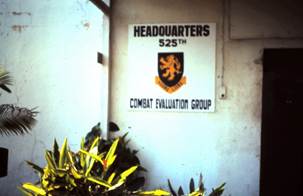
None of us had any real idea of exactly what was going on at that point. We just knew that the negotiations that had gone on for so many years finally seemed to be coming to an end. While I was stationed at Ap Bac in Kien Tuong Province 1969, I was there during the beginning of the withdrawal of forces. I was there when the Special Forces teams made their final withdrawal from Vietnam. We had a CIDG battalion in one of the districts that I worked with and they were one of the last of the special forces CIDG battalion advisors to leave Vietnam.
The last infantry unit actually withdrew in August of 1972 and most of the naval and advisors teams were either leaving Vietnam or had been withdrawn.
The Paris agreements required that all American combat forces be withdrawn from Vietnam. Unfortunately this did not end the war. On January 28th, 1973, armed conflicts were still occurring throughout the country
As far as the provisions of the agreement:
- the ceasefire was supposed to begin at 2400 hours on January 27th
- The withdrawal of all US and allied forces should be accomplished within 60 days
- All Prisoners of War were to be returned within 60 days.
- The United States military was required to clear all mines from North Vietnamese ports.
- Neither side agreed to recognize the legitimate border between the two Vietnams.
- The North Vietnamese were to respect the sovereignty of South Vietnam and allow for self-determination of what was to happen with the government there.
- The South Vietnamese government was required to recognize neutral political forces within the South. This would include the Việt Cộng infrastructure that existed.
- Both the North Vietnamese government and the South Vietnamese government were to be recognized as governments in the area.
- A tripartite reconciliation council was to be established in the South which consisted of South Vietnamese government the North Vietnamese government and neutralist.
- There was to be an organized free election for the establishment of a democratic government for South Vietnam.
- Relations between the United States and North Vietnam were to be normalized.
- The reunification of Vietnam through peaceful means without coercion or annexation by either party and without foreign intervention or interference.
- A joint military Commission composed of four parties and an international Commission of control and supervision composed of Canadian, Hungarian, Indonesian, and Polish forces were to implement the ceasefire.
- All foreign troops were to be withdrawn from Laos and Cambodia.
- There was a ban on the introduction of war materials into South Vietnam unless on a replacement basis.
- The agreement banned the introduction of additional military personnel into South Vietnam.
For those of us who were there we really didn’t have any idea of what was happening. We were waiting for additional instructions from our higher headquarters to determine what and how we would pull all the forces out of Vietnam. There was also a question as far as what forces were to be taken out and what forces were to remain.
Needless to say American embassy personnel were to remain. Personnel and logistical support for the embassy were also allowed to stay. This included some aviation assets and some logistical support. But when we were sitting at the 525th MI Group headquarters we really had no idea if we were going home or if we would be required to stay in Vietnam as a part of the forces that would remain. We had a interesting position in the military forces. While we were a USARV asset we also were responsible for providing intelligence to the South Vietnamese government.
It was finally determined in early February that we were to leave. I was already working with Det. 101 at that time and I was technically no longer at the 525th MI Group headquarters. I was serving as the Deputy Senior Advisor to that unit and we really had no idea of what was going to happen. It was very frustrating for us and for our counterparts.
One of the things that I did have to do though was clean out all of the 525th MI Group’s operational equipment and bring it over to Det.101. This was a massive operation. We went over with large 2-1/2 ton trucks and loaded up all of the equipment that we thought the Vietnamese could use. Fortunately we had a good Quartermaster Officer, our group’s S-4, who had a good idea of what we actually needed to take. We were very lucky that we had him. He prioritized the move and made sure that we got out all of the critical communications and support equipment first. We took out all of the radio equipment that we had planned on giving to the Vietnamese; we took out all of the service equipment as well. We removed all of the air conditioners and generators and heavy equipment first.
We were fortunate we did so. After the first week the commander of Tôn Sơn Nhựt Air Force Base realize that a lot of the top notch equipment was disappearing right under his nose. I always felt that he wanted that equipment for his personal use, items that he could sell. There’s a lot of graft and corruption there.
We would load our 2 -/2 ton trucks up and start driving off of the base and occasionally we would find a roadblock and if we were carrying equipment that belonged to the base commander, or at least the equipment he felt he should have, we would get stopped and searched and often the equipment would be confiscated. Needless to say we found out there were all kinds of back gates off of the Air Force Base and we got real good about using them. It wasn’t until we were moving the last of the office equipment and supplies that things got dicey.
We loaded up old wall lockers and old filing cabinets any remaining office supplies in one of the trucks and tried to sneak out the back door. We actually drove our truck through an open hangar and out the back gate. When we were finally stopped my driver had actually gotten us off the base but we were followed by a gun-Jeep. When they began firing at us we pulled over and stopped. We got out and they confiscated our truck and took it back onto the base. That was the last trip that we made off of Tôn Sơn Nhựt .
The USARV Commanding General ordered that no additional equipment could be removed from the base without the approval of the Vietnamese based commander.
Then came the wait!
Members of the unit were being sent home initially based upon their length of time in Vietnam. The men who had an upcoming DEROS (Date Estimated Return from Overseas) date we’re sent home first. The rest of us just had to sit there and wait for our orders and our assignments. We would report to the headquarters building every day and we would perform menial tasks hoping that our number would come up and we could go home. I was still a bachelor at the time and I was told that the bachelors would be the last men to leave. Command had decided that they were going to send the married men out first. However, those bachelors that already had a DEROS date left when their number came up.
We were still living in the BOQ at the time, I believe it was called the Utah BOQ, and every day more and more rooms would be emptied. We had a small, consolidated mess in the building and towards the first week of March it closed down as well. At that point we were all ordered out of the BOQ and sent to Camp Alpha. Camp Alpha was the staging location for all soldiers leaving Vietnam from the Saigon Area.
While we were at Camp Alpha we had absolutely nothing to do. They did have a nice little swimming pool there we lounged around the pool and read a lot of books and watched the buildings all around us start sporting North Vietnamese and Việt Công flags. It was disconcerting because we didn’t have any weapons, and if they had decided to capture all of us it would have been a very simple process. The only thing we had standing between us and our former enemies were the Canadians the Hungarians and the Poles.
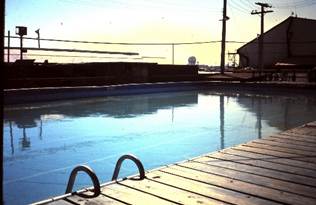
Camp Alpha Pool
One thing we did enjoy was the fact that in one of the buildings right next to where we were at Camp Alpha the Canadians and the Poles established their mess hall. I have to tell you the food there was fantastic. The food at the Camp Alpha mess hall was very poor quality. They were basically using up what they had in stock and trying to come up with meals based upon the materials they had on hand. As an officer I could sign myself out of Camp Alpha, and in some cases I went back down into Saigon and visited my counterparts.
The wait was difficult. We had no idea when we were going to leave and we felt in many ways that we were being used as pawns by both governments. They would tell us we had to leave on a certain date and then that date would change because there was more fighting that was going on that was reported. As a result we weren’t leaving at that point. We had a couple of these events that occurred and it kept delaying our departure.
I finally got my orders to leave at the very end. The 29th of March 1973 early in the morning we were awoken and told to make sure we had our gear packed and be ready to be processed to fly home. We gathered in the mess hall for a lousy meal. It was the traditional military ‘shit-on-a shingle’ or ‘SOS’ but it was watered down and on stale, burnt bread. The coffee was terrible, basically just hot water. But it was my last meal in Vietnam and I really didn’t care. After our breakfast we were ordered to bring all of our duffel bags or suit cases with us and prepare them for inspection by customs agents.
We were required to turn in all of our field uniforms at that point as well. I suppose they were going to reissue them to the South Vietnamese. I was allowed to keep my combat boots, the same steel-gray pair that I had originally worn back in 1969 on my first tour.
After we went through customs we had to turn in all of our Vietnamese money as well as our government script, the ‘funny money’ that we carried over there as opposed to American greenbacks. At this point we were allowed to exchange our money for American money as well as any value that we had in Vietnamese currency.
After everyone went through customs, and money exchange, we were given our final set of orders. I found that I was to report to Fort Leonard Wood Missouri to the 5th AIT Brigade.
About 10:00 we heard the whining of an aircraft engine and at that point we were all lined up and sent out to the airplane, our ‘freedom bird’, that was to take us home. Our duffel bags and suitcases all came out on carts and were loaded into the belly of the plane.
As we were all lined up, our former enemies, a senior Việt Cộng officer, an a senior North Vietnamese officer, as well as members of the Canadian, Hungarian, and Polish contingent stood there with clipboards and recorded the fact that we were leaving Vietnam. It was a strange sight. Our duffel bags were loaded in the belly of the plane and we were seated. A young Lieutenant from Camp Alpha came in and checked to make sure that everyone was there and that we were ‘all present and accounted for’.
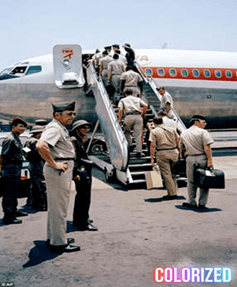
Note NVA and VC officers observing departure (Stock photo)
The door of the plane closed, the Captain came over the intercom and welcomed every one of us to the flight and told us that we would be home in about 22 hours.
We had some wonderful stewardesses on board and I felt sorry for them. Some of these guys were really wild. But I think they had made the flight a number of times with a bunch of homeward bound GIs and they treated us nicely. We weren’t allowed to drink because it was a military flight although I know that a few flasks were smuggled on board. The Air Force captain that I sat with had a flask and he and I enjoyed a rum and coke.
On the way home we played cards with an agreement that when we arrived in San Francisco that whoever won the game had to buy dinner. Needless to say we were both trying to lose. (Unfortunately, when we arrived at Travis AFB we were separated and I never saw him again, I owed him a steak!) We both did some reading, and we tried to sleep as much as possible. Our flight took us to Clark Air Force Base in the Philippines, and from there to Guam, from there to Honolulu, and finally to Travis Air Force Base in California. When I arrived at Travis Air Force Base I called my mom and dad and said I was home. I then called my fiancée and told her that I’d be in Minneapolis as soon as I could.
I made three trips to Vietnam, but I think the final return was the one I remember the most. Our war was over, we were going home for the last time, and the fighting and dying on the part of the US forces was over. I had spent one month (59 months), just under five years in the Army, four of them as a commissioned officer, and of the 48 months as an officer I had spent 29 of them in Vietnam.
Needless to say the provisions of the accords only lasted until early 1975 when the North Vietnamese government violated all of the agreements and attacked South Vietnam in earnest. I lost a lot of good friends over there as a result of that, my Vietnamese counterparts and probably their families as well.
We all felt terrible when we watched the fall of Saigon in April of 1975. A lot of us felt that all of the blood and treasure that we had spent over there had been wasted, that our government had abandoned our allies. It was a tough period of time for me because I had so many Vietnamese friends there.
Jump forward to our exit from Afghanistan; my son and his friends fought there and I know exactly how they felt when our government pulled out of Kabul in the untimely an unorganized mess that the administration created. I was especially mortified by the pullout from Kabul because I had been involved in doing war planning many years before for events such as that. What should have been a very organized and methodical approach to pulling the troops out turned out to be a debacle. Someone should have been fired!
If you’re enjoying these blogs please drop me a comment or if you have any questions that I might answer, again submit a comment on the comment pages. I’m always glad to hear from you.
Again, please take a look at all of my books that I have listed. They can be purchased from Amazon.com with the click of a button directly from my website, www.ptaylorvietnamadvisor.com. Until next Friday, Have a good week.
The Advisor Series:
- “The Advisor, Kien Bing, South Vietnam, 1969-1970. A Novel” (Available on Amazon ASIN: B09L4X5NQ3)
- “The Province Senior Intelligence Advisor, Kien Song Province 1970-1971; A Novel” (Available on Amazon ASIN: B0BHL2XCX5)
- “The Hardchargers,” Vietnam 1972-1973; A Novel” (Available on Amazon ASIN: B0C7SPR1JY)
- “The Tuscarora Trail” (Available on Amazon ASIN: B0D3QY2GM6)
Check out my website for other books that I’ve written or edited.
Website: ptaylorvietnamadvisor.com
 Peter A. Taylor's Home Page
Leave a comment