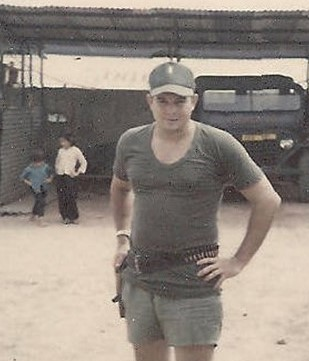
Based upon my writings you can probably easily tell that I was a Military Intelligence officer serving in Vietnam during my three tours over there. So, what was it like?
I had no intention of becoming a Military Intelligence officer. I enlisted in the United States Army in the US infantry, 11-Bravo. When I was selected for Officer Candidate School, I anticipated that I would go back to Fort Benning, Georgia for Infantry OCS. For some unknown reason the United States Army decided I should go to Engineer OCS, at Fort Belvoir Virginia. To this day I don’t know why. At that time Engineer OCS was a ‘branch immaterial’ course.
To be a combat engineer I would anticipate that your math scores had to be very good and I was a lousy math student in school. In fact, I found out many years later when I was in my 40s, I’m numerically dyslexic. Which sort of explains my lack of ability in high school and grade school to do math. I didn’t find out how bad it was until I was working on a master’s program, and I had to take a statistics course. So again why the army sent me to engineer school I don’t know.
As an OCS candidate I was required to apply for a security clearance. All officers were expected to have a minimum of a secret security clearance in those days. In most cases it took a number of weeks and sometimes months for someone to get their security clearance approved. Mine came through in a matter of a week.
There were two reasons for that; First, I had worked for a company in Springfield Virginia before I enlisted and we did high level printing for the Central Intelligence Agency as well as the US Navy. We all had to be cleared for a top-secret clearance. Secondly, my father was a high-level civilian at the Defense Intelligence Agency and as a result of his security clearances the entire family had to be vetted. As a result, all they really had to do was take a look at my previous security clearances and issue a new one. I had quit work at my company on Friday, and I enlisted on Monday morning. So, there wasn’t much of a break between my security clearances.
Be that as it may, I was very excited about becoming an engineer officer. I loved the construction part of our training, I enjoyed bridge building, and I thoroughly enjoy demolitions. In fact, the last week of my training at Fort Belvoir, I spent it out on the demolition range qualifying as a ‘master blaster’.
As we were approaching graduation, we were required to list in order the branches in the military that we would like to be commissioned in. I listed Infantry, Engineers, and Armor. When my official orders for commissioning came through, I found that I was to be commissioned in the Military Intelligence branch. It was a bit of a shock. I’ve always blamed my father and some of his friends at the Pentagon for the army’s decision. He always denied that he had anything to do with it. I’ve also ‘blamed’ General Graham, a close family friend who was serving as the Assistant Chief of Staff – Intelligence at the time of my commissioning. General Graham had sworn me in to the US Army and then participated in my commissioning as well.
So here I was assigned to the Military Intelligence branch. My first duty assignment was at Fort Holabird Maryland for my officer basic course. Here we learned the ends and outs of combat intelligence which was my initial assignment area. This was the general side of the Military Intelligence branch at that time. At the time the branch was divided into at least three and possibly four separate divisions. You could be a combat intelligence officer, a human intelligence officer, Counterintelligence officer, electronic warfare officer, or get training as a linguist or other very unique areas of the intelligence field. I was a combat intelligence officer. My training was to be able to identify a couple of major areas; enemy, terrain, and weather. We all suspected that we would go on to become a staff officer in a unit, and we knew we were all going directly to Vietnam.
I had already volunteered to go to Vietnam directly after commissioning. At that point in my life I had no intention of staying in the army and making a career out of it, well I figured I was going to have to go to Vietnam one way or the other so I might as well get over there and get it done, come home and take advantage of an early out and go back to college under the GI bill. Little did I know, 43 years later that I would finally take the uniform off.
Before going to Vietnam I was sent to the Jungle Warfare School in Panama. It was a relatively brief two-week course. We learned a little bit about the Vietnamese language and dealing with Vietnamese cultural conditions. We learned about survival escape and evasion, dealing with jungle diseases, and all things related to combat in a jungle environment. We covered a lot of material in two weeks. When my orders to Vietnam were finally cut it indicated that I was going to go into something called the ‘Phoenix’ program and assigned to the Military Assistance Command – Vietnam (MAC-V) specifically Advisory Team – 85. I had no idea what that was.
When I arrived at my team in Vietnam, I was sent to school at Vũng Tàu, to learn about dealing with counterintelligence, an area I had received no training in at all. At my officer basic course, we learned about the responsibilities of counterintelligence, but I received no specific training in that subject area. I now found myself involved in counterintelligence with the ‘Phoenix’ program. I’ve talked about that program in a blog that I posted on March 1, 2025.
But on a small district advisory team I was actually responsible for all areas of Military Intelligence, combat intelligence, actually participating in combat operations in the field. I had to learn how to develop agent nets which actually is a function of a human intelligence officer, I was responsible for radio security as well as counterintelligence trying to locate identify and eliminate members of the Việt Cộng infrastructure. It was quite a lot of additional learning to do, but I had some good coaching from our S-2 at province level as well as the NILO at the Navy base.
In all of these different capacities I had to perform various tasks. Prior to combat operation my role was to look at those factors that could influence our operations, what the enemy might do, what the enemy capabilities were, the effect of the terrain on our operation, as well as evaluating the weather.
In the area of electronic security, I had to make sure that our radios were properly protected from enemy surveillance. I had to make sure that call signs were in place and then we could communicate effectively with our base of operations at Moc Hoa while we were in the field or while we were at our team house.
As a human intelligence officer, I had to develop my own agent nets throughout our area of operation. While I will never go into the specifics, I can tell you that I had an extensive network of loyal Vietnamese operatives who provided me with excellent intelligence on what was happening in the area. But my responsibility was to go out and recruit these people.
As a counterintelligence officer I had to work with my counterparts in locating, identifying, and potentially neutralizing members of the Việt Cộng infrastructure. The Việt Cộng infrastructure was a shadow government ready to take over the government once Saigon fell (again view my post on March 1, 2025, for more information). These were the guerrillas that we had to separate from the local communities. This was a touchy business because we had to make sure that we were identifying the right person. In some cases, the local Vietnamese would attempt to use the ‘Phoenix’ program as a vendetta against their political or family enemies. So, we had to be very careful when we were making these identifications that we had the right person. We had to have at least three separate reports on an individual before we could even begin making an arrest and interrogating those individuals.
Again, as a Military Intelligence officer I was required to conduct interrogations. I know there’s a lot of things written about some of the atrocities that happened during interrogations in Vietnam. You hear the stories of three men lined up one man being shot and the other two being told “you’re next if you don’t tell us what’s going on”. There are stories about prisoners being thrown out of helicopters to their death as a part of interrogations. I never had to do any of that. My biggest threat to anyone who was captured was that they could either talk to me and end up in the American POW camps or I could turn them over to my counterpart and what happened was outside the purview of American control. I can tell you that my counterparts were not very respectful of the Geneva Accords in some cases. As a result, the vast majority of our prisoners wanted to talk to me. I would sit them down at a table facing me I would offer them tea or a cup of coffee or coke and we would have a nice discussion. My interpreter would sit by my side and would assist me with interrogations.
So, as you can see the role of a Military Intelligence officer with MAC-V was a very interesting assignment. I learned a lot about intelligence work, I learned a lot about dealing with counterparts, and more importantly I learned how to develop agent nets in the field. To my credit all the time that I was there I never lost a single agent.
I hope you found this interesting, and in later posts I’ll talk more about some of the specific things that I was involved with as a Military Intelligence officer in Vietnam. Each one of my three tours was different, my responsibilities were different, and my approach in dealing with the assignment changed with each new position that I held.
If you’re enjoying these blogs please drop me a comment or if you have any questions that I might answer, again submit a comment on the comment pages. I’m always glad to hear from you.
Again, please take a look at all of my books that I have listed. They can be purchased from Amazon.com with the click of a button directly from the website. Until Friday, Have a good one.
The Advisor Series:
- “The Advisor, Kien Bing, South Vietnam, 1969-1970. A Novel” (Available on Amazon ASIN: B09L4X5NQ3)
- “The Province Senior Intelligence Advisor, Kien Song Province 1970-1971; A Novel” (Available on Amazon ASIN: B0BHL2XCX5)
- “The Hardchargers,” Vietnam 1972-1973; A Novel” (Available on Amazon ASIN: B0C7SPR1JY)
- “The Tuscarora Trail” (Available on Amazon ASIN: B0D3QY2GM6)
Check out my website for other books that I’ve written or edited.
Website: ptaylorvietnamadvisor.com
 Peter A. Taylor's Home Page
Leave a comment