I grew up in a very strict Catholic tradition; baptized, confirmed, altar boy, Catholic schools, and attending catechism classes during high school. My mother even insisted that I do a pre-seminary year while I was in high school Just in case I had a vocation to become a priest.. My mother was a very traditional Roman Catholic. We went to mass every Sunday regardless of how sick you were or how tired you were you went to Mass.
With that type of upbringing serving in an area that was primarily Buddhist often left me with a little bit of a guilt feeling because I couldn’t make it to Catholic mass. However, as unchurched as we might have seemed to be, we actually took advantage of religious services whenever we could.
A couple of times I have mentioned religious services in my books, and I thought I’d give you a brief description of how we were able to attend religious services while I was stationed there. In most cases because of the size of our team, we didn’t see a military chaplain regularly. If we were at the provincial headquarters Team 85 in Moc Hoa occasionally we would have a minister, a rabbi, or a Catholic priest who would fly in for a Sunday service. On those rare occasions services were held at the club since it was one of the bigger meeting places on the compound, or services would be held in the mess hall.
In our case, because we were on such a small team, we rarely saw a military chaplain.
I was a practicing Roman Catholic, my Sergeant was a practicing Lutheran, and I don’t really believe that my Captain practiced any specific faith; I do know that he never attended services with us while he was stationed there.
We did have a Catholic Church in the little town of Ap Bac, and a Vietnamese Catholic priest would come there to say Mass a couple of times a month. He covered a parish that was quite large and as a result he was stretched very thin. However his parish did form around a Catholic Bishopric whose office and church were located In Nhon Nhin village. I’ll tell you an interesting story about the Bishop later.
Back to Ap Bac. The Vietnamese parish priest would usually send one of his acolytes to our team house and let us know that Catholic services would be held. On those rare occasions my Sergeant and I would try to attend services. Of course this was after Vatican II and the services were conducted in Vietnamese rather than Latin. However if he knew we were coming to Mass he would use the Latin vulgate for the actual conduct of the services. That way Sarge and I could look at my tattered and torn old Sunday missile and read along in English against the Latin translation. Needless to say the sermon would always be in Vietnamese and my Buddhist interpreter would sit between the two of us and interpret what the priest was saying to the best of his ability. I often wonder how much of the translation we actually got but I guess we sort of filled in the blanks as best we could.
As I mentioned my Sergeant was a practicing Lutheran but he didn’t mind going to Catholic Mass, he said that it was nearly the same service that he was used to in the Lutheran Church. He used to laugh and say that he was a Lutheran and the Lutherans were ‘Catholic-lite’. He said that he had a difference in opinion between faith and works and didn’t understand following the dictates of the Pope in Rome. We both enjoyed going to church together though.
Of course the area was prominently Buddhist and so on Buddhist holidays the three of us would, out of respect, go to the Buddhist temple for their services. We really didn’t participate but the monk would always introduce us and indicate he appreciated that we were attending.
Of course the crazy thing to me was the fact that the Buddhist would celebrate all of the Catholic holidays and the Catholics in the area would participate in all the Buddhist holidays; they may not go to church together but they all celebrate together. At Christmas in 1969 the Buddhist paraded into the compound with a small child in the lead. They were all dressed up in gaily covered clothes. They had drums and cymbals and they were singing chants that I think resembled Christmas carols. They brought flowers and fruit as gifts and then when they were done they all marched out of our compound and back to the church where they continued the feasting and a wild celebration.
The other big celebration was Tet, the lunar New Year celebration. While Tet did not have a spiritual component like Christmas and Easter it was still a massive celebration in the village and in the compound. After visiting friends and relatives and visiting the grave of their ancestors there followed a great party to attend. In the compound where we lived all of the children would receive a small envelope with brand new money in it. My interpreter went out into the marketplace and made sure that the 50 piaster notes that we had we’re all brand new bills. We would hand them an envelope. Families would visit grave sites and share a meal with their ancestors.
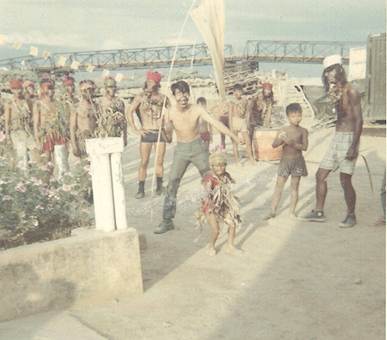
Christmas Celebration Ap Bac 1969
I was told that the eldest daughter in the family was responsible for maintaining the grave sites of their ancestors. This was considered to be a high honor for that woman, although a lot of husbands we’re always upset about the cost that was involved.
I mentioned the Bishop. I did not have a lot of dealings with him I met him two or three times when we were doing work in Nhon Nhin village. The village contained his large church, we would probably call it a cathedral, but in reality it was just a really large church. My favorite story about the Bishop was about his cat. He had the only domesticated cat that I think I ever saw in Vietnam. Cats were feral animals no one treated them as a pet. If they were a good mouser they might survive the rainy season. We often figured that we were eating cat in some of the meals that we had especially when no one could get outside the village and get to the market because of the monsoons. Here in my hometown we heard about a Chinese restaurant that was closed down by the sanitation department when they found the carcasses of some cats in one of their refrigerators. We don’t know if they were feeding Cat to their customers or not, but it really-really upset a lot of people, especially our cat lovers.
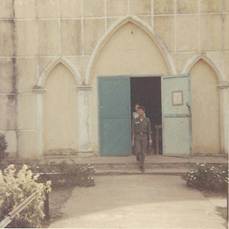
Bishop’s Residence Nhon Nhin Vietnam 1969
But no one messed with the bishops cat. I was told by my interpreter that no one dared approach the bishops cat, it was almost as sacred as the church was as far as they were concerned. I think they were afraid that he would put a hex on them if they even thought about putting his cat into a Stew pot.
Occasionally I would get into Saigon and when I did I would try to attend Mass at the main cathedral in downtown Saigon.
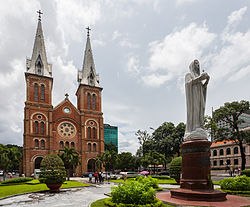
Notre-Dame Cathedral Basilica of Saigon
When I was in Saigon on my final tour working with Captain Phat I would always attend Mass with his extended family. One of his uncles was a cardinal in the church. Phat and I and his entire family would go to Mass at the cathedral every Sunday. The family even had their own designated pew. I was led to believe that their family had actually purchased that pew and there was a little name tag on the end of it that designated it was for their family’s use.
While the Mass was said in Vietnamese I had a translation copy that allowed me to go from the Vietnamese to the English. It was difficult to follow all the way through but after a while my Vietnamese was good enough to where I could get the gist of what was going on. Of course the biggest advantage is that the Catholic Mass was almost universal as far as its structure was concerned. The translated copy would always contain the English version of the gospel and the other biblical readings.
On two occasions while I was stationed at Ap Bac we did have a military chaplain visit our team briefly. The first one was a Presbyterian chaplain and the other one was a Methodist chaplain. We would sit and talk for about an hour and we would pray together prior to their departure.
I can tell you though that there were many-many Sundays where we were not able to go to services, either because the Catholic priest was not in town, we were in the field on an operation, or we couldn’t get up to the provincial capital to attend a service there. But we did try.
Regards, “Hardcharger”
If you’re enjoying these blogs please drop me a comment or if you have any questions that I might answer again submit a comment on the comment pages. I’m always glad to hear from you.
Again please take a look at all of my books that I have listed. They can be purchased from Amazon.com with the click of a button directly from the website. Until next week, Have a good one.
The Advisor Series:
- “The Advisor, Kien Bing, South Vietnam, 1969-1970. A Novel” (Available on Amazon ASIN: B09L4X5NQ3)
- “The Province Senior Intelligence Advisor, Kien Song Province 1970-1971; A Novel” (Available on Amazon ASIN: B0BHL2XCX5)
- “The Hardchargers,” Vietnam 1972-1973; A Novel” (Available on Amazon ASIN: B0C7SPR1JY)
- “The Tuscarora Trail” (Available on Amazon ASIN: B0D3QY2GM6)
Check out my website for other books that I’ve written or edited.
Website: ptaylorvietnamadvisor.com
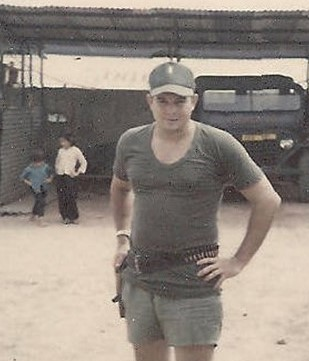
 Peter A. Taylor's Home Page
Leave a comment