As I’ve mentioned a couple of times in my writing the Plain of Reeds is one enormous swamp. And of course, we had basically two seasons over there it was either hot and wet or hot and dry. This was as a result of the monsoons and their effect on the weather. When I say wet, it would rain heavily two or three times a day and this rainfall was drenching. It could be so bad that some of our smaller teams actually built their team houses on 55 gallon drums so that they would float as the area flooded.
At the provincial capital of Moc Hoa we had an airfield. Originally it was a gravel landing strip built by the French back in the 1950s. At some point in time when the Special Forces Team, B-41, was there the runway was covered with PSP or Perforated Steel Platforms. These were large pieces of steel planking that locked together on top to form a solid surface.
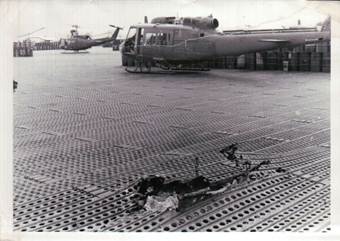
Runway made of PSP (Not Moc Hoa)
Aircraft could land at the provincial capital most of the year except during the heaviest period of flooding. Eventually the engineers decided to try something new. They brought in aluminum pallets. They were hollow and had a honeycomb interior. When these panels were locked together it made a very smooth surface.
The only disadvantage of the new runway was the fact that as the monsoon rains flooded the area the pallets were hollow, and they began to float. At one point they actually pulled the anchors up out of the ground and the runway was floating South and away from the city.
The interesting thing about the new runway was the fact that while it was floating, airplanes could actually still land and take off. But there was a catch. The airplane had to come in and land and slow down and continuously roll on the airfield. As long as it was moving there was enough buoyancy within the pallets to keep the aircraft from sinking. This created an interesting dilemma for passengers who were flying in on our little Air America aircraft called a Porter. The Porter was basically an aircraft used for carrying people and light critical supplies. When it landed it would begin its slow taxi towards the far end of the airfield, turn around and head back towards the airport kiosk. It would open the door, and people would have to jump out and quickly move away from the plane and move out of the way until they got to a platform built for them to stand on. If they stood still long enough in one place they would sink into the water. Passengers leaving on the plane would have to run up to the airplane and get in while it was still moving. I watched one aircraft go all the way to the end of the runway turn around slowly and go all the way back to the other end and repeat the process before everyone was unloaded or in the airplane. There was a berm around our compound, and we would often watch and laugh at the process.
Gary, our Naval Intelligence Liaison Officer (NILO) was a Navy Lieutenant (O-3 Captain other services). We decided one time to make Gary the airfield commander. We had done some research and found out that the definition of an aircraft carrier according to the US Navy was a vessel were a aircraft could land and take off while floating on the water. I’m sure this was a very old reference probably early 1900s to describe an aircraft carrier. We asked the Colonel to cut a Special-Order appointing Gary as the airfield commander, we then submitted his name to the Navy and asked that he be recognized as the youngest and most junior grade commander of an aircraft carrier in the United States Navy. Everybody thought it was a good joke. I doubt if the Navy ever recognized Gary for his achievement, but it was a good laugh; we made up a fancy certificate honoring his accomplishment!
During the dry season the area turned into a Dust Bowl. During the wet season, when you’re on a patrol, you had to worry about falling into a deep hole of water and drowning. During the dry season you had to worry about falling into a crack and breaking your leg or your ankle.
Our Boats
During the rainy season we had to travel by boat. Our team had two boats, one of them was our Kenner Ski Barge. The Kenner was 26 feet long and had twin 40 horse Johnson motors for our power source. It was a fast boat; I could actually keep up with the large Navy patrol boats and they could do about 28 knots. The Kenner was ideal for what we were doing along the canals, and we could even use it to get up into some of the very small streams that were in our area. In my book “The Advisor” I talk about conducting and ambushing a Việt Cộng tax collection cell operating on what I called Tram Key Stream.
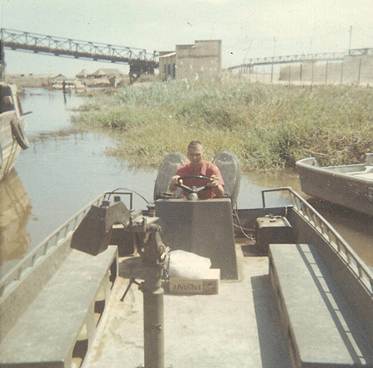
Our Kenner Ski Barge, SFC Fred Hartwick (Bob Bennet in my books)
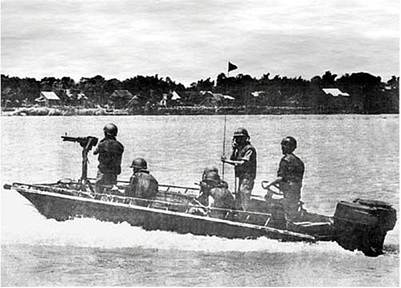
Kenner Ski Barge on the river
Our other smaller boat was a Boston Whaler, and we used if for short runs around the team house. In the photo below we were setting sensors along one of the major infiltration routes through the district. (In the photo below that’s the author in the water setting a series of intrusion detection devices along an infiltration route!)
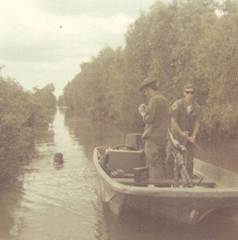
Our Boston Whaler
There were two major canals in our area, one called the Grand Canal or canal #12 which ran east and west through our district, and then there was another major canal that ran from the Vàm Cỏ Tây river outside of Moc Hoa, the provincial capital, all the way down to the city of Cai Lậy . While I never went to Saigon on the water it was possible to do that from our team house.
Land Transportation
It was possible to drive from our team house down to Cai Lậy and pick up the main supply route, MS-1, and from there we could drive all the way into Saigon. The road from Ap Bac to the West towards the Nhon Nhin villages ended right outside of town. So, if we were going West, we always had to take the boat regardless of the season.
We could drive east all the way to the Vàm Cỏ Tây river to the Navy base. This dirt road was open most of the year even during the monsoons, although there were a couple of low spots that we had to put it into 4-wheel drive and creep very slowly across some of the larger wet areas.

Our M-151 “Hardcharger” Team Jeep
There was also a road that ran from our town up to the provincial capital that followed the canal most of the way. It was passable most of the year although during the monsoons there were areas that we couldn’t drive through, we had to rely on the boat most of the time.
This created an interesting situation for the guys at the province team as well as the mobile assistance teams that worked for us in our district. During the rainy season they had no way of really getting out to pick up a very important commodity, beer. In our compound we had a large Conex container, and we used it to store beer and soda. We would drive into the city of Tân An to the 9th division headquarters go to the beer yard and pick up large quantities of beer in our Jeep and quarter ton trailer. It cost us $2.40 for a 24-can case.
We would bring the beer back to Ap Bac and store it in our Conex container; if I remember correctly we could store 9 pallets. That would work out to about 360 cases of beer and soda in our Conex container. During the rainy season the other teams would come to us, and we would sell beer to them. We charged them $2.50 a case. Needless to say, we didn’t make a lot of money on this operation, and we would use the proceeds from our sales to host picnics for our other advisors in the area. Each month we would try to get everybody together for a meeting, drink a little beer and have some good food.
A lot of times we’d alert Mr. John Paul Vann of our meetings and he or Colonel Hackworth, the Special Tactical Zone Commander, would come in and visit with the teams. A lot of times we would go down to the Navy base and scrounge a case of steaks or chicken breasts and have a BBQ. I would usually go down to the market and haggle with the old women for vegetables to make salads or in some cases for potatoes and we’d cook up ‘French fries. These little parties were always a lot of fun.
During the dry season the road to the provincial capital was always a bumpy mess. I had a habit of driving way too fast on the roads, and everyone laughed that I probably only hit every 4th bump in the road. It was ‘pedal-to-the-metal’. I’ve been told by other advisers who served in Vietnam before I got there that for a long time you couldn’t safely drive up that road. The only way you could do it was with an armed escort. By the time I got there the road was generally considered to be open all the time. Although I did have one incident along the road to Moc Hoa that was the final straw that got me kicked out of Vietnam.
In April of 1971 I had just applied for and been approved for a second extension of my tour in Vietnam. I’d just completed 18 months in Vietnam at that time, and I wanted to stay for another six. I know it was crazy, but I had a great job, I was working with good people, and felt that I was actually accomplishing something with my Vietnamese counterparts, so why leave?
My counterpart and I had a 5 million piaster (about $40,000.00 US) price on our heads put there by the North Vietnamese commander in our area. We were significantly damaging his operations! At that point there had been probably 3 attempts on my life that we knew about.
One morning I had driven down to do some coordination in one of our small villages. I was on my way back to Moc Hoa and as usual I was driving like a maniac. Some of the guys used to say that I didn’t hit every bump in the road; I was airborne more than I was road bound. From what we could figure I hit a command detonated road mine. Because I was moving so fast the guy that set it off was a second or too slow; I was slightly past the mine when it went off. It damaged the entire rear passenger side of the Jeep, but I was going fast enough that my momentum allowed me to roll into a small village on three good wheels. As soon as I came to a stop the Jeep fell over, and I got flipped out. But I was unharmed. When they got the Jeep back to the motor pool it was totaled. The motor Sergeant said there were 42 bullet holes in it and the right rear wheel was gone. He said if I had been driving normal speed I never would have made it through the ambush.
That was the fourth attempt on my life. The next morning, I found myself on a plane heading for Saigon and two days later on an airplane heading for home. They abruptly cancelled my second extension.
Air Transportation
The other way that we travelled was by helicopter. We had a helicopter that we called the “Swing Ship”, and it would make a run through the province a couple of times a week. Normally it would deliver administrative supplies and move personnel around the areas where they were assigned. You could also take the swing ship all the way into Saigon to Tân Sơn Nhứt Air Force Base.
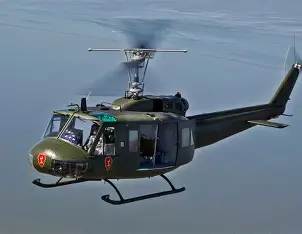
UH-1 “Huey” Our ‘Swing Ship”
If we were going to other locations such as Can Thơ, the capital of the Mekong delta we would take an Air America flight out of Moc Hoa. Air America was actually an adjunct of the Central Intelligence Agency’s operations in Vietnam. The pilots were really crazy, and we loved them. One time I was flying back from Can Thơ to Moc Hoa, and it was during the monsoon season. We saw this God-awful rain cloud ahead of us and the pilot indicated that it was too high for him to get over it. Rather than attempting to fly through the storm he landed on a dirt road. After the storm passed, he turned the plane around and took off on that same road, and we flew back to Moc Hoa.
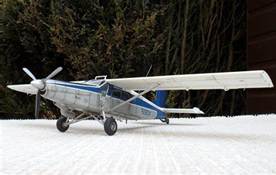
Pilatus PC-6 Porter (Air America Airplane)
Once you got to Saigon or Can Thơ you could catch a flight to almost any place in Vietnam. A lot of times we would fly what was called ‘Space A’, or space available. In other words, if there was a seat on a plane that was empty, we could get it. Two of the planes that did fly into our airfield occasionally were the C-140 ‘Hercules’, and the CV-2 and later C-7 ‘Caribou’.

C-130 Hercules
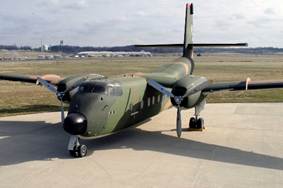
C-7 ‘Caribou’
So as you can see we had a number of ways of getting around in Vietnam by water, by road, by air and even to some degree a commercial airline flown by Air America.
If you’re enjoying these blogs, please drop me a comment or if you have any questions that I might answer again submit a comment on the comment pages. Glad to hear from you.
Again, please take a look at all of my books that I have listed. They can be purchased from Amazon.com with the click of a button directly from the website. Until next week, Have a good one.
The Advisor Series:
- “The Advisor, Kien Bing, South Vietnam, 1969-1970. A Novel” (Available on Amazon ASIN: B09L4X5NQ3)
- “The Province Senior Intelligence Advisor, Kien Song Province 1970-1971; A Novel” (Available on Amazon ASIN: B0BHL2XCX5)
- “The Hardchargers,” Vietnam 1972-1973; A Novel” (Available on Amazon ASIN: B0C7SPR1JY)
- “The Tuscarora Trail” (Available on Amazon ASIN: B0D3QY2GM6)
For more information visit Website: ptaylorvietnamadvisor.com
 Peter A. Taylor's Home Page
Leave a comment