A question always asked: What was your favorite weapon in Vietnam?
It never fails to amaze me how many people want to know about my favorite weapon that I carried in Vietnam. For many years I never really thought much about it, but we had access to a variety of military weapons. So today let’s talk about some of those.
When I went through basic training at Fort Benning GA I was one of the last basic training units to actually train with some of the old World War II weapons. In 1968 the army was in the process of modifying the M16 rifle. The original M-16s had a design flaw that created a real issue with jamming in combat. The weapon itself was re-engineered, and some major changes were made to modify the weapon. They added a plunger to the breach that allowed you to re-seat around if it didn’t fire. All of the new weapons were being sent straight to Vietnam and those of us in training trained on a variety of other weapons.
Initially we trained on the M1 Garand rifle as well as the M2 carbine. That was the first weapon that I actually qualified with on the firing range at Fort Benning. We also learned how to fire the .45 caliber pistol, and of course we all had to qualify with the fragmentation grenade.
When I did my Advanced Infantry Training at Fort Dix New Jersey we were training with the M14 rifle. The M14 was very similar to the M1 Garand except that instead of using a clip it used a magazine. During my advanced training we also got the fire the M60 machine gun. We were taught that the M14 replaced the M1 Garand as well as the M2 carbine and the old Browning Automatic Rifle the BAR
During my Officer Candidates School training in the infantry phase we had to go out and qualify again. We did get to see the M16 in training but none of us had an opportunity to fire it. We got some basic instructions but that was about the extent of it. Since we were all in officer training we did have an opportunity to fire the .45 caliber pistol as well as the .38 caliber pistol.
In 1969 when I arrived in Vietnam I was issued an M16 Rifle. When I got out on my team I finally had an opportunity to learn how to fire this weapon. My Sergeant took me out to the field, and he began instructing me on the care safety and handling of the M-16 rifle. One thing that I noticed right away was that it was a very easy weapon to shoot. It had a selector key that allowed you to go from single shot to fully automatic. It didn’t have much recoil or ‘kick’ which made it a lot easier to fire. There was a problem. It’s the same that I had during basic training as well as my advanced infantry training, I shoot left-handed.
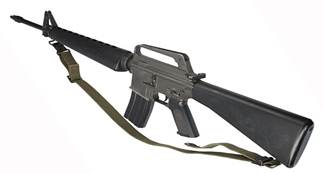
So why was this an issue? Well you see military weapons are designed for people who shoot right-handed. When you fire the weapon the hot shell casing is extracted and thrown to the right; when you’re shooting left-handed that hot shell casing can land on your arm and burn. As a result when I shot I had a tendency to flinch; as a result I wasn’t a very good shot.
As I described in the book, “The Advisor; Kien Bing , South Vietnam, 1969-1970”, my first real experience in a combat situation with the M16 rifle was reacting to an ambush along one of the canals. As Captain Pete Weatherall (Captain James West in my book) and I were going down the canal heading back to our team house we started receiving gunfire from the bank of the canal. I immediately engaged the target, and I had the weapon on fully automatic. I think I emptied four magazines as we drove out of the ambush zone. Captain Weatherall kept yelling at me to take aimed shots, rather than fire fully automatic. By the time I finally understood what he was trying to tell me we were safely out of the kill zone. At that point he decided that Sergeant Hartwick should take me out and teach me how to shoot.
Sergeant First Class Fred Hartwick,(Bob Bennett in my books) our team’s NCOIC, was a very good trainer. After an hour or so on the range he managed to teach me how to shoot right-handed. I didn’t have what’s called a dominant-eye so as a result he was able to work with me and train me to squint with the left eye when I was shooting. Because of his great instruction at least I could hit the target. But I never was a really good shot.
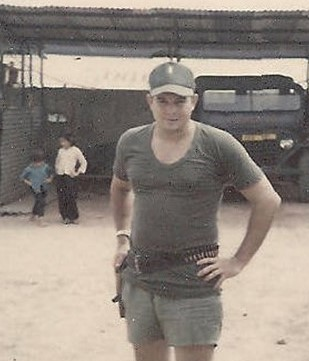
As a result Sarge decided that the weapon that I needed to carry was the M79 grenade launcher. With that I also had to carry a pistol. Once again it took a lot of training on his part and trial and error on my part to learn how to effectively fire the pistol. Initially I had a .38 caliber revolver that I liked. In fact in the picture you often see of me in Vietnam as a young Lieutenant that’s the weapon I’m carrying. However, Captain Weatherall, the District Senior Advisor felt that I needed something a little heavier than that “pea shooter” as he called it; as a result I began carrying the heavier .45 caliber pistol instead.
I loved the M79 grenade launcher. It was a single shot 40mm shotgun looking weapon. It would fire a 40mm grenade out to about 300 yards. But it also had a variety of other ammunition that made it a very versatile weapon. When we were operating in thick brush I would put a buckshot round in the barrel. It basically converted it to a large shotgun.
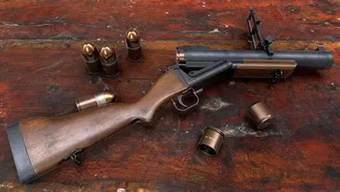
Other ammunition was available for the M-79. It would fire flares, Frechette rounds; hundreds of metal darts, and even had something called a Bouncing Betty. This round when it was fired would hit the ground and then bounce up before exploding. I could also fire a tear gas round through the weapon. As you can see it was a very versatile weapon.
We also had a M60 machine gun that we could mount on the front of our Kenner ski barge. The M60 Machine Gun has been the US Army’s general purpose machine gun since 1950. It fires the standard NATO 7.62 mm round and is used as a general support crew-served weapon. It has a removable barrel which can be easily changed to prevent overheating. The weapon has an integral, folding bipod and also could be mounted on our firing point in the bow of the boat.
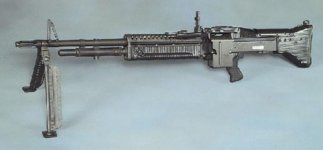
M-60 Machine Gun
Later on we were able to scrounge a M-18 Hand Cranked Grenade launcher from the US Navy. We could mount and fire it from the bow of the Kenner and it was a very useful addition to our arsenal. If fired a 50 round belt. Like an old gatling gun it was hand cranked and looked like a large revolver.
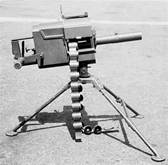
M-18 Hand Cranked Grenade launcher
This weapon is manually-operated and belt-fed. The use of a split breech mechanism allowed the weapon to be simple. The Mk 18 featured a pistol grip, iron sights, and a control knob with three different settings: Safe, Load, and Fire. I discovered that it was the only hand-cranked weapon to enter US military service since the Gatling Gun. Two rounds were loaded and fired for every complete rotation. Spent cases were reinserted into the belt. The weapon was light, weighing only 17 pounds, and had an effective range of 330 yards.
We also had a couple of captured AK-47 rifles as well as a B-40/41 RPG Chi-com (Chinese Communist) style Rocket Grenade launcher.
The AK-47 was a very reliable weapon. You could throw it into a mud pit, and it would still fire. The M-16 was a lot trickier; it required constant cleaning and would jam easily. The biggest disadvantage that I saw with the AK-47 was that the ammunition was a lot heavier. 200 rounds of AK-47 ammunition weights about 7-1/2 pounds while 200 rounds of M-16 ammo weighs about 2 pounds.
When we were working long range patrols some of us would carry the AK-47 rather than the M-16. The concept was that if we started receiving fire we could return fire with the AK-47 to hopefully confuse the Việt Cộng or NVA forces that we encountered. The AK-47 has a very distinctive sound when it fires as does the M-16 and the thought was that perhaps the sound would give us a few extra seconds to escape since the enemy might think that they were firing on their own troops. I don’t know if it ever worked or not, we never ran into enemy troops while on these secretive missions. But it always sounded like a good idea.
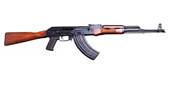
Chi-Com AK-47
There was always a concern when firing the AK-47; the ammunition. Throughout the war we would capture enemy ammunition from their caches and ‘spike’ ammunition with rounds that were loaded with high explosives rather than traditional gunpowder. When the weapon was fired the high explosive could blow up in the face of the person firing the weapon. We never knew if the ammunition we were firing was safe or not.
I got to fire the RPG B-40/41 a couple of times just to experience the weapon and its effects. It was a very simple weapon and easy to aim and fire. It was typically used against fixed positions or vehicles.
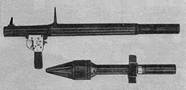
RPG (Rocket Propelled Grenade) or B-40/41
Our version of the RPG was the M72 Light Anti-tank Weapon (LAW). The rocket was in a launcher consisting of two tubes, one inside the other. “While closed, the outer assembly serves as a watertight container for the rocket and the percussion-cap firing mechanism that activates the rocket. The outer tube contains the trigger, the arming handle, front and rear sights, and the rear cover. The inner tube contains the channel assembly, which houses the firing pin assembly, including the detent lever. When extended, the inner tube telescopes outward toward the rear, guided by the channel assembly, which rides in an alignment slot in the outer tube’s trigger housing assembly. This causes the detent lever to move under the trigger assembly in the outer tube, both locking the inner tube in the extended position and cocking the weapon. Once armed, the weapon is no longer watertight, even if the launcher is collapsed into its original configuration. It is a line of sight weapon with a range around 660 ft”.
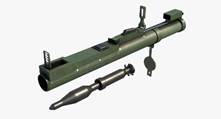
M72 Light Anti-tank Weapon – LAW
Our primary use for the LAW was bunker busting. It was a fairly accurate weapon and in the hands of an experienced operator it could be fired into a bunker or a defensive position with a good deal of accuracy. Back in the early 1970’s I submitted a recommendation for an improvement to the LAW (never accepted) to place stickers on the outside of the weapon indicating the most vulnerable parts of various types of Soviet equipment to show the gunner the best spots to disable or destroy a vehicle.
While this isn’t actually a weapon “Starlight” was a remarkable addition to our team’s night operations. We were able to take this unit to the field and set it up in our night-ambush positions.
The U.S. Army AN/TVS-2 Night Vision Sight for Team Weapons is a first generation night vision device, first developed during the Vietnam war era, which quickly went through several different revisions. This particular scope is version 2B. While very large and heavy by “modern” standards, the 20 pound passive starlight TVS 2s were considered state of the art when it came to the capabilities of U.S. troops fighting at night.
These scopes first entered service at the height of the Vietnam War, and despite their cumbersome size and weight, they did prove its use among Soldiers and Marines in their patrol bases.
Out of the container it looked like a large telescope and when you looked through the sights you got an eerie greenish glow. We usually set it up on a small tri-pod but in ambush positions we could steady it with a sandbag. It was easy to determine of someone was armed since the ambient light would shine on the metal of a gun barrel. In “The Advisor” I talk about the use of the Starlight in determining the route of attack on the outpost at Long Thieu as well as US Navy usage from the decks of Patrol Boats.
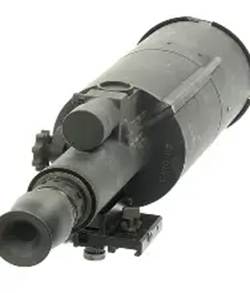
U.S. Army AN/TVS-2 (Starlight) Night Vision Sight
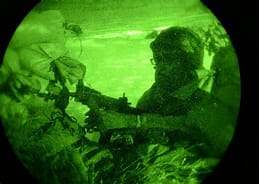
Visualization of an object through Starlight
So, when I’m asked about my favorite weapon in Vietnam it had to be the M-79 Grenade Launcher. It was a relatively light-weight weapon with a wide variety of available ammunition. I wore a mesh vest that had pouches for grenades of all types. I got to the point where I could actually lay three rounds on-target at about 200 yards at the same time. I would have one round in the chamber one in my mouth and one in my left hand. I would fire the chambered round at a high elevation, hit the lever and eject the spent casing, take the round from my hand and load it into the weapon and fire at a different elevation; when I fired my last round, the round from my mouth, it would be a direct line-of-sight shot. If I had my angles right all three rounds would impact on a target simultaneously.
It was a simple weapon to maintain, and the ammunition was very reliable. It was a great weapon; I loved my “thumper”.
If you’re enjoying these blogs please drop me a comment or if you have any questions that I might answer again submit a comment on the comment pages. Glad to hear from you. Again take a look at all of my books that I have listed, They can be purchased from Amazon.com with the click of a button directly from the website. Until next week, Have a good one.
The Advisor Series:
- “The Advisor, Kien Bing, South Vietnam, 1969-1970. A Novel” (Available on Amazon ASIN: B09L4X5NQ3)
- “The Province Senior Intelligence Advisor, Kien Song Province 1970-1971; A Novel” (Available on Amazon ASIN: B0BHL2XCX5)
- “The Hardchargers,” Vietnam 1972-1973; A Novel” (Available on Amazon ASIN: B0C7SPR1JY)
- “The Tuscarora Trail” (Available on Amazon ASIN: B0D3QY2GM6)
For more information visit Website: ptaylorvietnamadvisor.com
 Peter A. Taylor's Home Page
Leave a comment