Welcome Back!
As advisors, we encountered changes in our diets. Initially housed at a large replacement depot in Saigon, I awaited my assignment at Camp Alpha, located at Tân Sơn Nhựt Airforce Base. During this time, we processed in, received uniforms, weapons, field equipment, and managed (or mismanaged) administrative and financial matters. My pay and finance records were misplaced by the US Army.
We ate in a military Mess Hall (yes we still called them Mess Halls in those days and not “dining facilities”) during our brief stay in Saigon. Food there was actually pretty good. We were on something called a 14-day menu IIRC. In other words, meals were designed to follow a specific daily menu that didn’t repeat itself for two weeks. I never had the opportunity to stick around long enough to see if that was true or not. As an officer I paid a small amount for my meals consumed because I was drawing a food ration entitlement which I lost once I went to the field!
When I received my first set of orders I was flown to Can Thơ the headquarters of the Delta Military Command (DMAC). I was housed in temporary quarters for a few days of additional in processing. Since my pay records weren’t with me (they had been lost in the shuffle in Saigon) I had to draw a temporary ‘advance’ on my monthly pay and allowances. This would become my standard pay system for the remainder of my tour in Vietnam. Each month I would have to go to Can Thơ and receive an ’advanced’ pay until I returned to the US and could get my pay resolved.
In Can Thơ we ate at another Mess Hall, this one at Advisory Team 96 for my next few days of in processing and my final reassignment to Advisory Team 85 at Moc Hoa, Kien Tuong Province. Prior to my departure one of the other officers and I went into downtown Can Thơ along the Bassac River and had a fantastic meal at a riverside restaurant. It was the first time I had ever had Crab asparagus soup. It was absolutely fantastic. I’ve tried to replicate that dish back home, but I’ve never been able to duplicate that delicious meal. Every month when I went to Can Thơ I tried to eat at that same restaurant and I tried a number of other seafood dishes, but my favorite was always the Crab soup.
When I arrived at Moc Hoa I was once again eating in the Mess Hall. I do have to say that I was impressed with the food there. Our Mess Sergeant had to work with the 14-day menu, but he really did a great job of obtaining a variety of local vegetables, spices and other dishes to disrupt the routine. His coffee was superb! I understand that he had a ‘special mix’ that he used. I never found out what he was mixing into his coffee, but it was really good.
Once a week he would always serve grilled steaks. As I understood it he would trade with the US Navy detachment at Moc Hoa and get cases of steaks in exchange for providing the Navy Chief’s with hard liquor that they weren’t technically allowed to consume at their facility. That was a persistent rumor and what I found out down at my team in Ap Bac, probably a fairly accurate assumption. I understand that he was also usually able to obtain cases of chicken from the Navy as well.
A few days after my assignment to Team 85 I got sent to Vũng Tàu to attend my initial Phoenix school. Another ‘rough’ assignment!
We were housed in the old Roman Catholic Seminary at Vũng Tàu and we were fed by one of the local military units. Our class was small and that way they didn’t have to worry about the overhead required to run a mess hall for so few of us. But the great thing about Vũng Tàu was the fantastic seafood that was locally available. We ate at a new restaurant almost nightly during that two week course. The cuisine varied depending upon the catch of the day.
The Vietnamese preparations were usually simply baked and garnished with a variety of exotic vegetables. The French-style fish that we ate were served in elaborate sauces and lightly fried or broiled.
The biggest difference with the Vietnamese-style was that the fish was generally bake with the head on and the entrails were often served separately. I learned not to ask about what I was eating until afterward. Most of it was delicious but if you asked first what was being served you might not want to try – you’d miss out on some excellent foods that way!
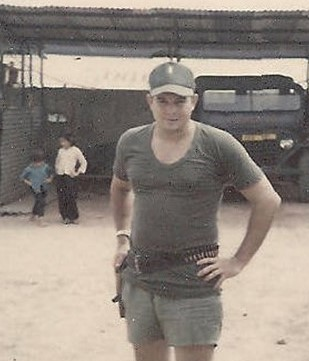
When I returned to Moc Hoa, the Provincial Capital, I stayed there for just a few days before shipping down to the three-man team in Ap Bac. That’s where my real indoctrination in local Vietnamese cuisine really began. It was a real experience, especially for a young kid from Virginia.
We usually went downtown to a small place along the canal for coffee and pho for breakfast. If you aren’t familiar with pho it’s a soup that is served very hot that contains some noodles as well as bean sprouts and a diced up hot pepper called a ‘chi ug’ (don’t know about the spelling!). Our medics wanted us to eat the chi ugs daily. It seems that it was the local remedy for some of the nasty stomach issues that you could get eating on the economy.
But the old woman who ran the restaurant/coffee shop also made some marvelous baked goods. The rule was that you could eat them as long as you saw them coming out of the oven. Her bread was excellent, but again the rule was it had to be hot when we ate it. It seems that she had once worked for the French Administrator in the district and she had learned how to make French pastries and bread.
The coffee was done in an European style. It was served in a small demitasse cup. She would fine grind coffee beans and place them in a small sieve-type cup on top of the coffee cup and then pour boiling water through the ground beans and into the cup.
Coffee was served either ‘din’ or ‘sucre’; ‘din’ meant black and very bitter while ‘sucre’ was served with condensed milk and sugar. They thought that it was strange that I preferred coffee-din, but I liked good strong coffee. The other option was trà, or tea. But that’s another part of the story!
Our cook/maid helped the District Chief’s cook prepare the afternoon and evening meal. We would traditionally eat during ‘pot time’, between noon and three p.m.. This was the heat of the day and little or nothing happened during that time period. Even when we were in the field on operations the Vietnamese would cook rice with some fish sauce and either a small amount of pork or some dried salted fish. Back at the team house the meal was usually a relatively light one, rice, some meat and lots of tea!
The ‘big’ meal was traditionally consumed at the end of the workday between six and seven in the evening. Initially we would eat with our counterpart and his “niece”. Our housekeeper/cook would assist in the kitchen cooking the meal and then the two women would serve the meal at the table.
We ate in the kitchen around a large round table. The Vietnamese captain would sit on one side and his “niece” would serve him while our housekeeper would serve the three of us. When I say serve, it was a strange relationship between the Captain and his “niece”. It was a subservient relationship. She would remain silent at all times with her eyes fixed on him. If he needed anything he would nod, and she would serve him. One time I asked her a direct question, and she began to respond when the Captain gave her a nasty look and then answered my question. It seems that she wasn’t allowed to speak except through him.
I learned a lot at that table. I was able to improve my Vietnamese, although I never felt that I was near fluent. But emersion definitely helped a lot.
There were some interesting ‘food lessons’ at that table. At my first meal I was served chicken, a staple in Vietnamese cooking. But unlike chicken in America the head and feet were left on the bird when it was cooked. As the ‘guest’ I was served the bird with the head facing me, and I had no idea what to do. How do you eat the head of a chicken? My boss explained to me that this was ‘an honor’ and that I was to ‘address the bird’ and then compliment my host.
Baked fish was also served with the head unremoved, complete with eyeballs. I found out that the soft flesh under the cheek was considered a delicacy as were the cooked eyes. The entrails were also cooked and served as a side dish. I was warned that there were some entrails that were not to be consumed, but they ‘added color’ to the plate.
A pungent fish sauce called ‘nước mắm’ was served at almost every meal. It was traditionally sprinkled on rice to add some flavor to the meal. Nước mắm was oily, and normally seasoned with spices and hot-hot peppers. I found out that it is actually made from rotting fish. Along the main rivers the fishermen would hang large thin nets and collect the unused parts of fish. The rotting juices would drip onto concrete containers an this was the beginning of nước mắm’. Like many things in Vietnam the quality of nước mắm’ was graded from one to ten.
Number One nước mắm’ was considered to be top quality. It was refined, aged and sold at a high price in the market. The lesser quality nước mắm’ was graded all the way to Number Ten – the lowest quality and probably just the raw fish oil. We ate only Number One nước mắm at our table, but in the field the soldiers got small packages of nước mắm’ to eat with their rice – it was probably Number Ten it smelled terrible and was extremely spicy to cover up the odor and taste.
This numbering system was a bit baffling for me at first. I asked our Cô (our housekeeper) to get me a #10 can of coffee from the supply cabinet. I wanted a large can of coffee to fill the container next to the coffee pot. She gave me this unusual look and went outside and brought me an old coffee can that was in terrible condition. It was rusted and beat up badly. She handed it to me with this quizzical look, like’ OK Lieutenant this is the worse coffee can that I can find, I hope that this is what you want!’ Oh well, lessons learned!
Every meal was served with rice, nước mắm, some form of meat or fish and a variety of vegetables. Afterwards the men would gather in the Captain’s office for tea. This was an interesting ritual. I found out that tea was as much of an important ritual as wine-tasting is to those of us who enjoy a good glass of vino.
Teas were served at various times of the day, and each time period required a special tea. I can’t remember the correct sequences, but morning tea was a darker tea served with or after breakfast before the business day began. We would meet with our counterparts and discuss the plans for the day and drink one or more cups of tea. A luncheon tea was served with the meal and afterwards what we referred to as “pot-time’ tea was served after lunch during the heat of the day. Often this tea was iced and very sweet. At four pm ‘formal tea-time’, a holdover from Chinese tradition would be held.
Our counterparts “niece” or wife would serve this tea using formal cups and accompanying it with a sweet bread/cookie. There was a lot of ritual involved with this tea service. Cups were held in a certain way and turned gradually clockwise and then counterclockwise as we sipped the tea. Our counterpart would then tell us about that special tea, where it came from, it’s history and describe the unique taste. I never got beyond the point of remarking that it was good tea! Barbarian!
While chicken, pork and fish were staples we also ‘enjoyed’ some more exotic fare. During the monsoon season snake and rat were often served. Now when I say rat, we automatically think about sewer rats; not so, these were field rats akin to a muskrat. They were the size of a small-sized dog. They were captured in the rice paddies and were good eating. I can say that they tasted a lot like rabbit or squirrel. They were usually cooked in a stew and served over steaming bowls of rice or noodles with the ever present nước mắm.
Snake meat was also served often during the monsoons when it was plentiful, and it was difficult to get out of the village to make major purchases.
Snake meat is terribly stringy and tough. It is basically the two large pieces of muscle that run along the back spine of the snake. The meat has a rather unique gamey-taste. The meat was traditionally sliced into small pieces and then tenderized with a wooden mallet before being cooked for a long time and made into a very tasty stew or soup. My counterpart used to say that it was a medicinal soup that would cure a variety of ailments. My boss used to call it Vietnamese Chicken Soup. Some say that it tastes like alligator.
Well enough about food at this point. I’ll regale you with a couple of other ‘food stories’ in later blogs.
Next week exotic drinks.
If you’re enjoying these blogs please drop me a comment or if you have any questions that I might answer, again submit a comment on the comment pages. I’m always glad to hear from you.
Again, please take a look at all of my books that I have listed. They can be purchased from Amazon.com with the click of a button directly from the website. Until Friday, Have a good one.
The Advisor Series:
- “The Advisor, Kien Bing, South Vietnam, 1969-1970. A Novel” (Available on Amazon ASIN: B09L4X5NQ3)
- “The Province Senior Intelligence Advisor, Kien Song Province 1970-1971; A Novel” (Available on Amazon ASIN: B0BHL2XCX5)
- “The Hardchargers,” Vietnam 1972-1973; A Novel” (Available on Amazon ASIN: B0C7SPR1JY)
- “The Tuscarora Trail”(Available on Amazon ASIN: B0D3QY2GM6)
Check out my website for other books that I’ve written or edited.
For more information visit my website: ptaylorvietnamadvis
 Peter A. Taylor's Home Page
Leave a comment