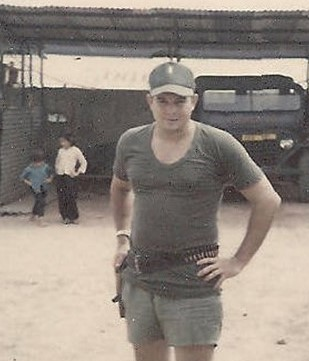
My recent blogs have dealt with some Vietnam War stories from my first book in the Advisor series, “The Advisor; Kien Bing, South Vietnam 1969-1970”, (available on Amazon.com).
What I’ve tried to do is to expand upon what I’ve written in my novel about my time in Vietnam during my first assignment there. For someone who is not in the military or has a deep understanding of what soldiers went through in Vietnam I thought it would be interesting if I explained some of the terminology, programs, personalities, and some of the feelings that we had on being there. In later blogs I will continue to talk about some of those unique experiences.
But if you look at my list of books, you’ll also notice that I have written a number of books on the Civil War. I think I’ve always been interested in the Civil War period; I grew up in the 1950s and the 1960s during the 100th anniversary of the Civil War. As a kid we had all kinds of newspaper stories that were printed in the daily newspaper about what happened on that day in Civil War history. My history teacher in school loved teaching history about the Civil War. I was fortunate that when I went to the US Army War College in Carlisle PA that I actually got to study in great detail the Civil War. I’ve immersed myself in the history of that war studying the leaders, tactics, and the methods that were used in the fighting of the great conflict
I have a cabin in the Shenandoah Valley right in the heart of so many of the Civil War battles that took place in Virginia. I’ve been involved in Civil War roundtables for many years; I’ve been a guest speaker at those roundtables. I’ve led ‘staff rides’ to a number of battlefields and every year I took my JROTC cadets to the battlefields of Gettysburg or Antietam. So as you can see I’ve always been fascinated by the Civil War.
When I retired from the US Army I moved to a little town in West Virginia, Clarksburg. I started a Junior ROTC program at the local high school and taught there for 17 years.
A few miles from our house is one of those first battlefields of the US Civil War, Philippi; or the ‘Philippi Races’. In early June of 1861 at the very beginning of the conflict Confederate forces had assembled at Philippi and on June 3rd, 1861, they were attacked by Union forces and driven from the town. Some consider this to be the first land battle of the Civil War.
We also have remnants of our own Civil War emplacements and earthworks here in the town of Clarksburg. One of the very famous generals of the US Civil War, Thomas “Stonewall” Jackson was born in downtown Clarksburg, Virginia.
While Thomas J. Jackson may have been born here in Clarksburg, he didn’t live here very long. His mother was widowed, remarried, and moved to Parkersburg, (WV) Virginia. When his mother passed away young Thomas Jackson moved to Jackson’s Mill, outside the town of Jane Lew, and lived with his uncle.
At the very beginning of the COVID lockdowns I had been in Washington DC at the US archives researching events here in Clarksburg. What I found out was fascinating. This small town had been the logistical center of the Union war effort between 1861 and 1863. Even through 1864 and 1865 our town played a significant role in supplying troops that were fighting in western Virginia and as far East as the Shenandoah Valley.
I came home to Clarksburg on Sunday and the following day COVID closed down Washington DC. However, I had over 1,800 photographic pages of information, almost a day-by-day coverage of events in Clarksburg. I had a plethora of information from the daily Orders Book pages maintained by the Garrison’s Adjutants covering everything from June 1861 through September of 1866. I was only missing about three months of records in 1864. I was able to use newspapers from that period to cover events for the book.
As I did my research I found out that the first land battle of the US Civil War almost occurred in downtown Clarksburg, roughly six weeks prior to the battle of Phillipi. It nearly happened in front of the current site of the Huntington National Bank on Pike St. in downtown Clarksburg.
On May 23, 1861, the local Virginia state militia unit, “the Harrison Rifles” was ordered by the Virginia governor in Richmond to muster into the Virginia militia at the Harrison County courthouse. Earlier in the year a rival militia unit, loyal to the federal government, “The Union Guard” had formed and had seized the militia weapons that were stored in Clarksburg.
Late in the afternoon of May 23, 1861, the Harrison Rifles were spotted moving into town along the Northwest Virginia Turnpike. The alarm was sounded and the Union Guard formed along the turnpike in front of what is today the Huntington National Bank (Pike Street and Second Street). The well-armed Guard faced a motley crew armed with hunting rifles, clubs and sharpened spears. The Union Guard was armed with the standard militia weapons, supported by a six-pound brass cannon. It appeared that bloodshed was forthcoming.
Into the middle of this potential fray stepped a notable citizen of the town, Mr. Waldo Goff. Mr. Goff had held a number of civic positions and was a highly respected citizen. Mr. Goff got between the opposing forces and basically told them “Not here boys!” and defused the situation for the time being. Each side agreed to go home peacefully. The Harrison Rifles agreed to give up their weapons under the guardianship of the local sheriff’s office if the Union Guard would return to their homes. Thus, ended what might have become the first land battle of the US Civil War.
The following morning about 105 members of the Harrison Rifles marched from Clarksburg east to Grafton where they were accepted into the Confederate Army. They became a part of the “Stonewall” Brigade, the 31st Virginia Infantry. They fought through the entire war and were present at Lee’s surrender at Appomattox Court House. Eight of the original group managed to return to Clarksburg at the end of the war.
So, what made the little town of Clarksburg so important? First and foremost a major railroad line came through our town. The Northwestern Virginia railroad connected Grafton, Virginia (WV) and the Baltimore and Ohio Railroad with Parkersburg, Virginia (WV) on the Ohio River. At the very beginning of the war this rail line became one of the major entry point for Union units fighting in North Central and the northern part of western Virginia. Another major entry point in the state was South of Clarksburg about 100 miles along the Kanawha River.
Additionally, the Northwest Virginia Turnpike, a macadamized, all-weather road, ran from Parkersburg to Winchester Virginia (now US-50). Another important road ran south from Clarksburg to Weston (now US-19), and others connected the towns of Philippi and the strategic rail center of Grafton. Thus, Clarksburg was a transportation hub.
The importance of Clarksburg is that it would become the logistical center for supplies and equipment coming into the Mountain Division’s theater of operation. Clarksburg was also a central headquarters for military units that were protecting the Baltimore and Ohio railroad that ran from Harpers Ferry, Virginia (WV) through Grafton VA (WV) and north on to Wheeling Virginia (WV). The Northwestern Virginia railroad ran from Parkersburg all the way to Grafton where it linked up with the B&O railroad.
Parkersburg was the major logistical center along the Ohio River. Units from Ohio, Indiana, Illinois, Michigan, and other western states often marched through Belpre, Ohio and crossed the Ohio River into Parkersburg Virginia (WV). Once they were in Virginia they would take the Northwestern Virginia railroad from Parkersburg to Clarksburg.
In May of 1861 the population of Clarksburg was about 800 citizens, and the county population was about 2,400 souls. All of the sudden between 3,000 and 7,000 Union troops began arriving in town and filling up all of the open areas that could be found.
Not everyone was pleased with the town. One Regular Army officer stationed in Clarksburg had a very low regard for the municipality:
“This “Ancient Metropolis of Western Virginia,” as its people delight in calling it, lies in a little valley, on one side of which runs Elk Creek, and on the other the West fork of the river. On all sides loom up wild, desolate-looking hills, covered to their summits with the “forest primeval.” The town itself is only approached by dilapidated-looking bridges across the streams before mentioned, and is laid out irregularly, with little regard to artistic taste or beauty. It is a motley collection of rickety frame houses, dirty-looking brick dwellings, and old stone buildings, some of which are propped up by large pieces of scantling, the shattered monuments of the first families of Virginia. For the most part, the grounds around the dwellings are alike destitute of good taste or comfort.
The town boasts a Court House (a most extra-ordinary specimen of architecture), which is used for every purpose besides its legitimate one: for fairs, balls, parties, political, indignation, and other meetings. Almost every sect is represented by a Church, the most of which have been sadly disfigured by the troops occupying them for barracks. There is also an Academy, which has been turned into a guardhouse and prison, for the numerous political prisoners sent there. An air of listless inactivity broods over the whole town. Many of the people are hospitable and kind, the ladies refined and educated have more energy than the men who, for the most part, are lazy, indolent, and delight in interfering with the affairs of strangers.
Their principal occupation, in the drowsy summer afternoons, is to sit upon their doorsteps, with their little negroes playing at their feet, gazing into the street; at times discussing the war, and marking out plans for our Generals to follow. Pacing along the deserted streets in the twilight, the only sounds which are heard beside the tramp of your own footsteps, are the merry ringing laugh of childhood, the tinkle of a distant cowbell, and the braying of the Government mules. The languid inactivity of the town reminds one of those primitive Dutch places in New York, so graphically described by Washington Irving.”
Other’s had a different view of Clarksburg. Future President of the United States, Rutherford Birchard Hayes, wrote to his wife:
CLARKSBURG, VIRGINIA, July 27, 1861, (?) (I believe) Saturday (I know).
DEAR WIFE: –Our second day, from Bellaire to this place, was an exceedingly happy one. We travelled about one hundred and thirty miles in Virginia, and with the exception of one deserted village of Secessionists (Farmington), we were received everywhere with an enthusiasm I never saw anywhere before. No such great crowds turned out to meet us as we saw from Indianapolis to Cincinnati assembled to see Lincoln, but everywhere, in the corn and hay fields, in the houses, in the roads, on the hills, wherever a human being saw us, we saw such honest spontaneous demonstrations of joy as we never beheld elsewhere.
Old men and women, boys, and children–some fervently prayed for us, some laughed and some cried; all did something which told the story. The secret of it is the defeat at Washington and the departure of some thousands of three-months men of Ohio and Indiana led them to fear they were left to the Rebels of eastern Virginia. We were the first three-years men filling the places of those who left. It was pleasant to see we were not invading an enemy’s country but defending the people among whom we came. Our men enjoyed it beyond measure. Many had never seen a mountain; none had ever seen such a reception. They stood on top of the cars and danced and shouted with delight.
N.A. Barrett, writing to the Western Reserve (Warren County Ohio) chronicle wrote:
Leaving Parkersburg at 6 P. M., we found ourselves the next morning at Clarksburg, the county seat of Harrison County and the supposed future capital of western Virginia.
Here camp life commenced in earnest. received our tents, pitched them in regular ardor, and made ourselves comfortable to the best of our ability. We were in Clarksburg but three days on the morning of the fourth we started, in soldier style, with knapsacks on our backs and guns on our shoulders across the country in the direction of Philippi.
Captain Charles Leib (see my book; “The Most Hated Man in Clarksburg”) was the first Assistant Quartermaster General assigned to the town at the very beginning of the Civil War. He had the monumental task of establishing what would become a critical logistical center for the early days of the Civil War. Leib ultimately established a major quartermaster station to collect, secure and issue enormous amounts of equipment to the militia units that were initially sent to the town. When he arrived, he found enormous amounts of supplies and equipment dumped along the side of the railroad tracks.
Leib spent the next nine months constructing the headquarters and garrison areas in the town. At least six and possibly as many as eight regimental sized camps were established in and around the town to support the troops passing through on their way to the “Seat of War”.
On the top of Lowndes Hill, which overlooks the downtown area, the local militia established a series of earthworks to protect the city from what was thought to be an imminent attack by Confederate forces in May of 1861. The scare never materialized, and the earthworks were not occupied until the scare of the Jones Imboden Raid in 1863, Later in the war additional artillery emplacement were added above the town overlooking the railroad. Those earthworks are still visible today.
Clarksburg was the initial site of the West Virginia statehood initiative. After the vote in Richmond to secede from the Union, representatives from the western counties of Virginia met here and openly discussed their intent to establish a new state. They ultimately moved their meetings to Wheeling, but the statehood talks began at our county courthouse. The town was, at one point, considered as the potential state capitol because of its importance as a transportation center.
All but one church in the city was ‘requisitioned’ by the Federal Army. Most were used as barracks, hospitals or officers’ quarters. The Episcopal church in downtown Clarksburg was the only one spared the indignations that befell the other places of worship. Other public buildings were seized for the use of the military. Homes of prominent secessionists who fled Clarksburg were also seized and used to support the Union army. Many were used to house ranking officers stationed in town or as hospitals for wounded and sick soldiers.
Captain Leib confiscated a large orchard near the railroad station and converted it into the paddock for the 1,700 horses and mules that were maintained in Clarksburg for military use. The orchard had been owned by a secessionist who fled Clarksburg and served in Richmond, Virginia in the Confederate legislature.
Throughout the war Clarksburg was a hub of activity. Regiments came and went. The Garrison headquarters was a center of administrative and military operations. Supplies went from Clarksburg south to support units as far away as Weston and Gauley Bridge, and east as far as the Shenandoah Valley. After the Battle of Gettysburg, the importance of logistical operations from Clarksburg lessened as the Civil War’s emphasis was on Virginia and the Union Army regained control of much of the Valley of Virginia.
For detailed information about Clarksburg in the US Civil War I would recommend my book, “A Civil War History of Harrison County West Virginia, 1861 – 1865: Harrison County, Virginia (West Virginia) in the Civil War 1856 – 1865” Paperback, ASIN: B0B1CLL28Q (Available on Amazon.com), visit my website: petetaylorauthor.com for direct ordering from Amazon.
All proceeds for the sale of this book go to support the Harrison County Historical Society.
I hope you are enjoying these reminiscences in my blog. I encourage you to read my books about Vietnam and the Civil War. I hope that you continue to enjoy my blog.
Regards “Hardcharger”
Next Week- Some Science-fiction adventures.
If you’re enjoying these blogs please drop me a comment or if you have any questions that I might answer, again submit a comment on the comment pages. I’m always glad to hear from you.
Again, please take a look at all of my books that I have listed. They can be purchased from Amazon.com with the click of a button directly from the website. Until Friday, Have a good one.
The Advisor Series:
- “The Advisor, Kien Bing, South Vietnam, 1969-1970. A Novel” (Available on Amazon ASIN: B09L4X5NQ3)
- “The Province Senior Intelligence Advisor, Kien Song Province 1970-1971; A Novel” (Available on Amazon ASIN: B0BHL2XCX5)
- “The Hardchargers,” Vietnam 1972-1973; A Novel” (Available on Amazon ASIN: B0C7SPR1JY)
- “The Tuscarora Trail”(Available on Amazon ASIN: B0D3QY2GM6)
Check out my website for other books that I’ve written or edited.
For more information visit my website: ptaylorvietnamadvisor.com
 Peter A. Taylor's Home Page
Leave a comment