This is a question that is well over sixty years old. Was my going to Vietnam worth it and was it worth the blood and treasure of the United States.
Guenter Lewy, a German-born American author and political scientist estimated 1,353,000 total deaths in North and South Vietnam during the period 1965–1974 in which the U.S. was most engaged in the war. Lewy reduced the number of Viet Cong (VC) and People’s Army of Vietnam (PAVN) battle deaths (We called it ‘body count’) claimed by the U.S. by 30 percent and assumed that one third of the reported battle deaths of the PAVN/VC may have actually been civilians. He estimates that between 30 and 46% of the total war deaths were civilians. His estimate of total deaths is reflected in the table.
| Deaths in Vietnam War (1965–1974) per Guenter Lewy | |
| US and allied military deaths | 282,000 |
| PAVN/VC military deaths | 444,000–666,000 |
| Civilian deaths (North and South Vietnam) | 405,000–627,000 |
| Total deaths | 1,353,000 |
Other estimates from the Vietnamese government in the 1990’s report that 3.4 million military and civilians died as a result of the war. Regardless of the numbers the loss of life was tremendous on all sides of the conflict.
According to the US Archives a total of 50,441 American personnel who were KIA or died non-hostile deaths, were enlisted personnel and officer casualties were 7,877. I was told that the life-expectancy of a second lieutenant in Vietnam was 19 seconds. I had a great Sergeant, and I beat those odds; I was a dumb second lieutenant but smart enough to listen to an experienced, combat hardened, non-commissioned officer!
So why did we fight that war? A good question with a lot of potential answers I’m sure.
One theory was the ‘domino effect’. There was a fear that if Vietnam fell to the communists that all of the rest of south Asia would eventually fall as well, If we could stop the Chinese from spreading the communist influence in Vietnam we could halt the spread of communism throughout Asia.
Another theory was that South Vietnam was the ‘breadbasket’ of Asia. If we could stop the Chinese from getting their hands on the Mekong Delta and the other rich rice producing areas that they would be forced to look towards the Soviet Union as their source of food to feed their masses. Neither the Chinese or the Soviet Union really liked one another at this point in history and this competition might work in our favor.
There was this constant fear in the 1960’s that the communist world was spreading rapidly and that the democratic nations needed to stop it’s spread. This fear of communist world domination concerned all at the geo-political level. We were afraid of losing our trading partners as well as our political influence around the world. Communism was ascendant and democracies felt threatened.
Our politicians and planners saw a glim light in the possibility of saving the self-proclaimed country of South Vietnam from this communist onslaught. They felt that the anti-communist regime in the southern portion of Vietnam could be that bulwark against the expansion of communist influence into the rest of Southeast Asia. We had some treaty guarantees and as a result we got drug into what was basically a civil war.
As early as 1962 some leading military men, including General Creighton Abrams and my mentor, then an Army Lieutenant Colonel, John Paul Vann questioned our involvement in Vietnam. Many like Vann were silenced by those in the Pentagon who were supportive of the South Vietnamese government.
The ‘reasons’ for involvement in the Vietnam Conflict were many; the results?
So Why Did I Go to Vietnam?
I enlisted shortly after the Pueblo Incident in 1968. The North Koreans had seized a US Navy intelligence collection ship in international waters and were holding the ship and its crew inside North Korea. Tensions were high.
I had dropped out of college and was working at RCA Government Services in the print shop. I could have applied for an industrial deferment, but…
I received my notification to report to Richmond, Virginia for my pre-induction physical. I was rated 1A, so I knew that I’d probably get drafted. This was the period prior to the draft lottery so getting called up was almost guaranteed if you were 1A and didn’t have a deferment.
I came from a family with a long line of national service, so enlisting was somewhat expected. My dad and uncles served in WWII and my Grandfather had been an artilleryman in WWI. I had relatives who had served in the Continental Line during the Revolution as well as a distant grandfather who had served as a cavalryman in the Civil War. So my enlisting was somewhat expected.
During my pre-induction mental testing my scores indicated that I was qualified to attend Officer Candidate School once I completed my Basic and Advanced training, if I wanted to attend. My recruiter also tried to get me into the Army Security Agency program as a linguist. But I elected to enlist in the Infantry. I figured I was going to Vietnam anyway and I wanted as much combat training as I could get. Since I figured I was going to a combat zone I wanted to be as prepared to face my assignments there as possible – the Infantry was the way to get that training.
After my Basic training at Fort Benning I was sent to Fort Dix, New Jersey for my Advanced Infantry Training (AIT). Upon completion of my training there I had to wait around for a few months to begin my Officer Candidate School.
Since there was an extended period of time between the end of AIT and my next assignment to OCS I was kept at Fort Dix in my former unit as a ‘duty soldier’. My First Sergeant arranged for me to attend the Combat Medic Course that was forming up in the unit next to ours. Since I had already completed the field training that they were required to undergo all I had to do was attend the actual medical courses. Training consisted of advanced first aid and combat medicine. This training has proven to be invaluable over the years.
I expected that I’d go back to Fort Benning, but I ended up at Fort Belvoir, Virginia instead in Engineer OCS. Belvoir OCS was one of the branch immaterial Officer Candidate Schools. While our training emphasized engineering skills, graduates were commissioned in a number of combat support branches such as Quartermaster, Transportation and Military Intelligence. Twenty-six weeks later I graduated as a Second Lieutenant and was commissioned as a Military Intelligence Officer in late May 1969. I’ve always felt that they US Army placed me in Military Intelligence since I already had a Top Secret security clearance prior to my entry in the service. I held this high level clearance because of the work that I had done in the print shop at RCA Government Service Co. before my enlistment.
During my last couple of weeks at Fort Belvoir I got to select my choice of my next duty assignment. I volunteered for Vietnam. I figured that I was going there anyway so I might as well get it over with. I knew that guys who went to Vietnam could get an early-out when they got home, and I figured that I could get back to civilian life quicker that way – little did I know; forty-three years later I finally took off my uniform and hung it up permanently!
I actually got called into see the psychiatrist when they saw my request for Vietnam. At first he figured that I had a death wish. But as we talked the Captain realized that I was sane and had good reasons for getting it done quickly, He wished me a safe and productive year and said that he prayed for all of our safety over there.
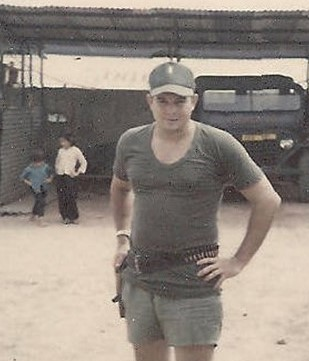
By September of 1969 I found myself assigned to a Military Assistance Command – Vietnam advisory team in the Mekong Delta in Kien Tuong Province. Nineteen months later I got kicked out of Vietnam (Read all about it in my Advisor series).
I was assigned to Reserve Advisor duties in St. Paul, Minnesota. I hated my assignment there and the only way that I could get out of it was volunteering to go back to Vietnam, which I did. The only good thing I can say about my assignment there was that I met my future wife, Mary Jo, there and we’ve been happily married for over fifty years.
In the early fall of 1972 I went back to Vietnam and served with the 525th Military Intelligence Group (read all about it in “The Hardchargers”). I was one of the last combat troops to leave Vietnam on March 29, 1973.
So like 70% of the troops that went to Vietnam I was a volunteer. I went because that’s where I figured a serving officer should be if there was a war being fought. Call it patriotism or stupidity; your call! But I went, served and returned in one piece. I’m proud of that service and proud of my brothers and sisters who were over there with me. We share a bond that is unbreakable;
Welcome Home my Brothers and sisters, We Made IT!
Would I do it again?
Well if they needed a 77 year old retiree with a bad back, and a lot of other old-age issues, you bet I would! There is no higher honor than to serve my country if needed! God Bless the USA!
If you’re enjoying these blogs please drop me a comment or if you have any questions that I might answer, again submit a comment on the comment pages. I’m always glad to hear from you.
Again, please take a look at all of my books that I have listed. They can be purchased from Amazon.com with the click of a button directly from the website. Until Friday, Have a good one.
The Advisor Series:
- “The Advisor, Kien Bing, South Vietnam, 1969-1970. A Novel” (Available on Amazon ASIN: B09L4X5NQ3)
- “The Province Senior Intelligence Advisor, Kien Song Province 1970-1971; A Novel” (Available on Amazon ASIN: B0BHL2XCX5)
- “The Hardchargers,” Vietnam 1972-1973; A Novel” (Available on Amazon ASIN: B0C7SPR1JY)
- “The Tuscarora Trail”(Available on Amazon ASIN: B0D3QY2GM6)
Check out my website for other books that I’ve written or edited.
For more information visit my website: ptaylorvietnamadvisor.com
 Peter A. Taylor's Home Page
Leave a comment