I found this interesting article on-line and it is worth sharing with my readers. It is translated from Vietnamese to English and I’m certain that there are a number of translation issues however the gist of the material is very interesting. Much of it is a military history of the Kien Tuong Province and US and ARVN operations. It is a lengthy article and includes operations after the US involvement in Vietnam.
Moc Hoa in the Vietnam War – Tran Ly
Posted by bienxua on October 28, 2024
Tran Ly
Excerpted from the https://dconnect.co.jp/friend/tranly/ website
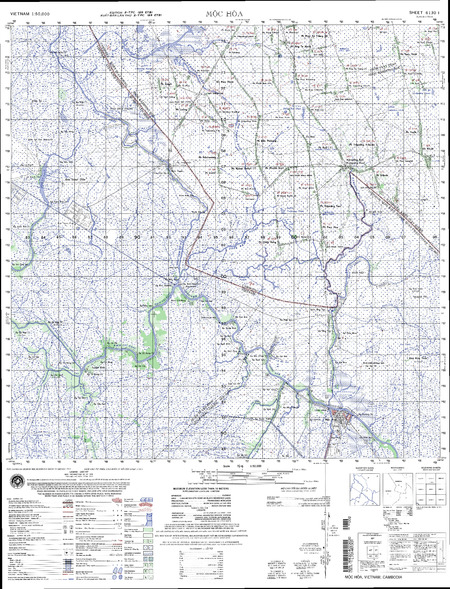
Map of Moc Hoa, of Kien Tuong Province of maps.lib.utexas.edu/maps
- Geographical features
Moc Hoa is the provincial capital of Kien Tuong Province
Kien Tuong province is bordered by Cambodia to the north, Long An province to the east, Dinh Tuong to the south, and Kien Phong province to the west.
The terrain of Kien Tuong is a low-lying area, most of the South is swampy, the melaleuca forest of the “Dong Thap Muoi” area extends from the southeast of the Love That Phong spreads through:
Dong Thap Muoi is the name of an area of about 700 thousand acres in the west, located in the heart of the provinces of Chau Doc, An Giang, Sa Dec, Kien Phong, Kien Tuong, Dinh Tuong, Long An and Tay Ninh. spread to Cambodia.
Vam Co Tay River flows along the length of the province; to Long An to meet the Vam Co Dong River in Can Duoc.
Interprovincial Highway 29 is the only road in the province that connects the districts to the provincial capital
Tinh Kien Tuong was established by Ngo Dinh Diem on February 17, 1956 and then consolidated on October 22, 1956 (Decree 143-NV) including Moc Hoa (Chau Thanh), Kien Binh, Tuyen Binh and Tuyen Nhon Districts.
By road from Saigon take National Highway 4 to Cai Lay and follow LTL-29 to Moc Hoa.
Moc Hoa Airport: 78 km west of SG, 2900 ft long rocky runway
- Special Forces Camp :
The U.S. Special Forces arrived in Moc Hoa on October 15, 1964, when the 1st A-221 Squadron arrived in Kien Tuong to study the establishment of Reconnaissance Camps near the Mien-Viet border. On March 7, 1965, the team moved to Long Xuyen and the CIDG Training Program was assigned to Troop A-524 (belonging to the 5th SF), the temporary camp was initially called Camp Dan Cuong (A-414). As the program expanded, a B team was achieved in Moc Hoa and there was a Forward Base in An Long. (A-432). After the Labor Camp in Hiep Hoa was flooded and destroyed by the Communist Party. Moc Hoa was chosen as an operational center of the LLP and the location of the Command of the B-41 (Camp O’Toole). control the Front Lines in Mingzhou, Chau Hui, Cai Doi, Bien Hiep and Thanh Tri.. Moc Hoa is also the Base of A-414 (B-41 has many dependent units including Health, Telecommunications, Intelligence, etc. Technique..)
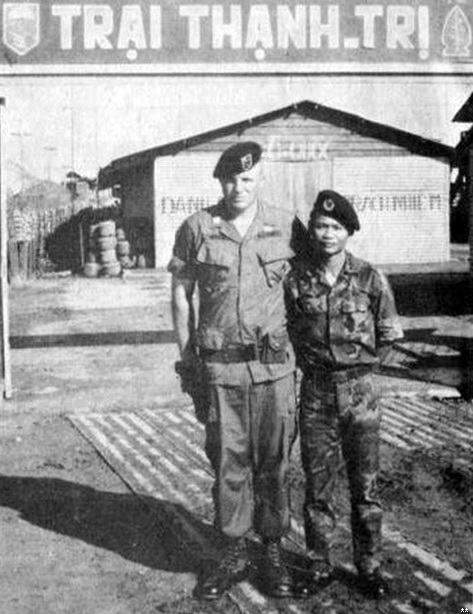
Thanh Tri Camp (Photo by Wall-of-Faces).
Moc Hoa Camp A-414 was moved to Thanh Tri on March 15, 1968 and still retains the same Registration No. A-414 (Region 4 Labor Camp was built ‘less’ more fortified than Camps in other regions such as 1 and 2 because these camps were located in remote and isolated locations)
The commander of Team B-41, Lieutenant Colonel Joseph Fernandez, used the old Base as the headquarters of Team 6 A under the jurisdiction of Kien Tuong Province
Kien Tuong is also home to the ‘headquarters’ of MAC-V team 72, which includes the activities of CIA-related organizations such as CORDS and USAID. and the same building of the B-41
MAC-V has 2 L-19s of the US Army, permanently parked at Moc Hoa Airport, used to communicate directly with Saigon.
- Moc Hoa where the weapon was tested:
- Xuồng bay = Airboat (Det A-441)/A-404
In February 1968, Lieutenant Colonel Ludwig Faistenhammer, commander of Team D (Delta) began the reorganization of the 4th Mobile Strike Force (4MSF). The A-441 team moved from Moc Hoa to Cao Lanh and changed to A-404 to operate the program ‘Flying Boat’
The Flying Boat Project was tested by the U.S. Headquarters in December 1960 with 2 swamp buggy and scrapped because it was considered unsuitable for the Vietnamese battlefield (see Tran Ly’s Naval Force). In the spring of 1964, the US Armed Forces, operating in the Mekong Delta, needed small boats, carrying 3-4 soldiers, capable of moving quickly on swampy and submerged areas. The U.S. Military Command in Vietnam (MAC-V) approved on June 19, 1964 the purchase of six flying boats from two private manufacturers, tested and evaluated. As a result, Hurricane Fiberglass’ Aircat was selected and the U.S. Army purchased a total of 84 aircraft in early 1966 for $6,000 each.

The ‘Hurricane Aircat’ airboat; dimensions 5.2 m x 2.2m depth 0.10m ; tonnage 520 kg; 180 hp Lycoming O-360 aircraft engine; speed 78-120 km/h; range up to 160 km. The canoe shell is made of 5 layers of fiberglass. The canoe can glide on shallow water, launch over the bank of a low dike.
Armament : 1 .30 machine gun or 1 .50 machine gun mounted on the bow of the canoe; The officers were armed with personal firearms at their discretion. Mounting tests for 57 mm recoilless guns and 106 mm guns.. are all inappropriate. (Gun 57 due to recoil; Gun 106 is too heavy to carry . . . bullets!)
The AN/PRC-25 telecommunications boat and this is the main obstacle: the engine is too noisy, so telecommunication is very difficult. although there is an improvement, such as using AN/VRC-12, using a noise isolation helmet but not achieving the desired results.
Summary of the LLB recorded in 1965: Flying boats used in 104 collisions killed 86 VCs, destroyed 26 CQ boats.
During a ‘tao wu’ battle in November 1965: a VC platoon was caught while traveling by boat to Moc Hoa.. This platoon was completely destroyed.
The organization of the Flying Boat Detachment was ‘completed’ on November 1, 1968 with the tactics applied such as operating in groups of 6 boats (2 equipped with 0.50 guns / 4 equipped with .30 guns), operating in coordination with helicopters.
The CIDG airboat consists of 3 personnel: a boat driver, a machine gunner and an auxiliary gunner equipped with 1 M-79). The team of 6 boats has 1 more nurse and a mechanic.
The ‘flood’ season of 1968 showed that the Detachment was very effective in reconnaissance and guarding and escorting canoes. ambush CQ…
The activities of the Flying Boat caused a lot of losses to the CQ units operating in the Dong Thap Ten area, so the Kien Tuong Provincial Party Committee had to send the Ca Mau Battalion, 2nd Regiment (TrĐĐ U Minh) to Svayrieng to learn how to fight Flying Boats! On 29 July 1969, this CS unit returned and organized an ambush at Camp Tra Cu (A-326) This battle caused 1 SF killed, 2 CIDG wounded, but due to the timely intervention of PBR (HQ) and helicopters, CQ suffered heavy damage.
October 6, 1969. a convoy of 75 armed boats of CQ moving from Mien to Moc Hoa was found by L-19 (at Moc Hoa) and reported to the Flying Boat (A-432) Thuong Thoi to intercept. 20 VC boats withdrew to Mien, but the Flying Boat stopped them in time. and armed helicopters to gunner.. CIDG forces from Chi Lang were transported into battle by helicopter. The CQ delegation was almost destroyed. 3 Flying boats were damaged by artillery fire on the other side of the border, 1 helicopter fell due to propellers.. slashing water… (The tools were all picked up by Chinook about Cao Lanh )
On 23 October, the flying boat at Vinh Gia (A-404) intercepted and attacked the convoy of 60 CQ boats, and sank 16 boats. without loss.
The Flying Boat Program ended in the early 1970s: The number of organic flying boats of Team D was now about 80. From August 1970, Team D withdrew from Cao Lanh to Can Tho. handed over a number of flying boats to the ARVN Army (some documents say that the Engineers of the 9th and 21st Infantry Divisions used these flying boats?)… The repair facility at Cao Lanh Pharmacy was assigned to the Support and Logistics Company of the 4th Regiment on November 14, 1970
(Note: Mien Navy, Sihanouk era -[1967-73], with 2 Aircats, acquired by CSBV from CIDG in October 1967)
Please read more about Flying Boat and CIDG in the article ‘LLDB Fighting by Boat’ (Tran Ly)
- Monster Campaign
While the UN took care of testing the ‘Flying Boat’, the US HQ had a test of a new weapon in the area of Dong Thap 10. find a boat that can operate effectively on rice fields and flooded swamps. At the end of 1966, the U.S. HQ tried using PACV (Patrol Air-Cushion Vehicle) ‘Patrol Air-Cushion Vehicle’ at Dong Thap. Although PACV has been tested in Market Time and Game Warden Campaigns in Tactical Zone 1, the results do not meet operational standards…
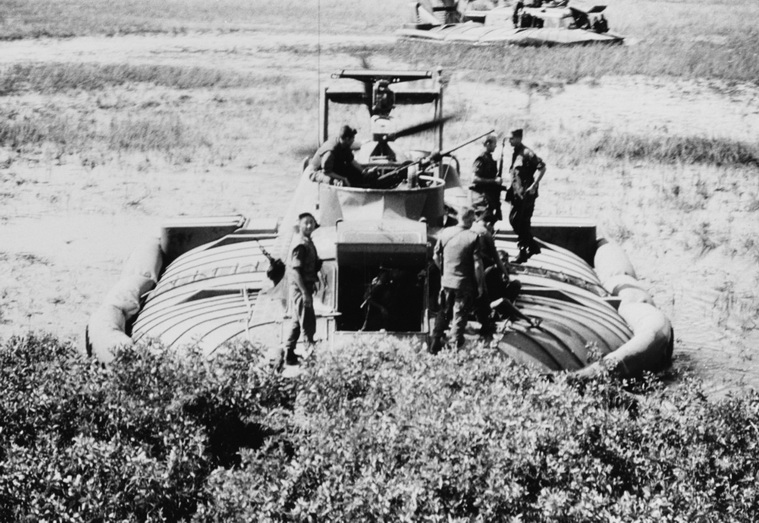
The US Navy’s PACV air mattress warship operates in Moc Hoa (Photo by Naval History and Heritage Command).
The 107 PACV team of the US HQ was brought to Moc Hoa for testing. The team consisted of 3 PACVs manned by 4 HQ Officers and 15 sailors. in coordination with the B-41 Squadron to provide a squadron 8-12 CIDG. according to PACV.
The PACV is 11.8 m (39 ft) long, 7.2 m 24 ft wide) powered by a GE 7LM100-PJ102 gasoline turbine that provides thrust and lift for a large 7 ft fan and rear propeller. The lifting fan unit forms a 4ft thick air mass under the rubber cover of the mattress, so the lifting of the flying mattress is on the field surface. The rear propeller helps the mattress move and orient in a flying boat style. Range 300 km. PACV equipped with machine guns, : 1 .50 twin machine guns; or M60 ; grenade launchers, employees including 1 SQ and 3 union members. (navigator, gunner, radar operator..)
During the testing period, the PACV was operated in coordination with motorboats, flying boats and helicopters and other aircraft. The combination of PACV and Armed Helicopter is considered the most successful because the helicopter reconnaissance targets and points out the concentration position of CQ. A separate helicopter detachment was organized for joint testing with the PACV: the ‘Seawolf’ using the Army’s UH-1s. At the same time, a ‘new’ type of aircraft was also being tested with PACV, the OV-10A reconnaissance aircraft of the ‘Black Pony’ Team
The “Monster” campaign lasted 16 days in Moc Hoa and as a result, 3 PACVs destroyed 70 CQ bases, sank 70-80 boats, captured 11 CQs alive, and killed 23 CQs. The PACV proved to be quite effective and Monster is the CQ name given to this type of air mattress and ordered local units to avoid clashes with the PACV.
The cons of the PACV are that it is too ‘noisy’ (like a Flying Boat) and the price is ‘too expensive’: almost 1 million dollars a piece! (compared to PBR only 90 thousand dollars and Flying Boat 6 thousand) In addition, maintenance is quite complicated: 20 hours of maintenance is needed for every 1 hour of operation!
The PACV program in Vietnam continued with the Army and ended in 1970
Note: The U.S. Army also tested three ‘Air Cushion Vehicles’ called ACVs (Air Cushion Vehicles) divided into two types: AACV= Attack (A= Attack) and TACV= Transport and Resupply (T=Transport). The Army test team is located in Ben Luc and Dong Tam. The Army lost 2 ACVs to CQ mines.
- RUDD = Remote Underwater Detection Device
This is a river mine detection system using a mobile ‘listening’ and sonar system, with a cord up to 1 mile long, tested at Moc Hoa, during Operation Slingshot.
– Shower boat:
An ATC with two additional high-pressure pumps on the top battle deck forms a water jet water cannon system with a pressure of up to 3000 psi that can destroy CQ’s bunker without bombs.
- Moc Hoa and the ‘intelligence’ war
According to Joe Leeker’s “Air America in South Vietnam” (symbol V-51), where many special flights use Helo Courier and 6-8 Volpar 4-seat aircraft to communicate and gather intelligence for MAC-V. Air America’s helicopters also pick up ‘civilian’ employees (!) The United States came out of Moc Hoa on the day.. April 13, 1975 ?
- Gamma Plan
This was a ‘top secret’ plan aimed at gathering intelligence on CSBV bases inside the Mien territory and the contact between the Mien Government and CSBV. The plan was assigned to the B-57 U.S. Army: On February 28, 1968, this team moved from Saigon to Nha Trang and from April 1 to April was confirmed as the Command of Project Gamma. The plan has 5 intelligence-gathering teams and 4 facilities to synthesize and exploit ‘information’ and operate a ‘network’ of covert operations. In Region 4: there are two ‘stations’ located in Moc Hoa and Chau Doc. The Gamma Plan was later expanded by the addition of the ‘Blackbeard’ Program, increasing the number of personnel to 13 ‘nets’ and 98 ‘spies’
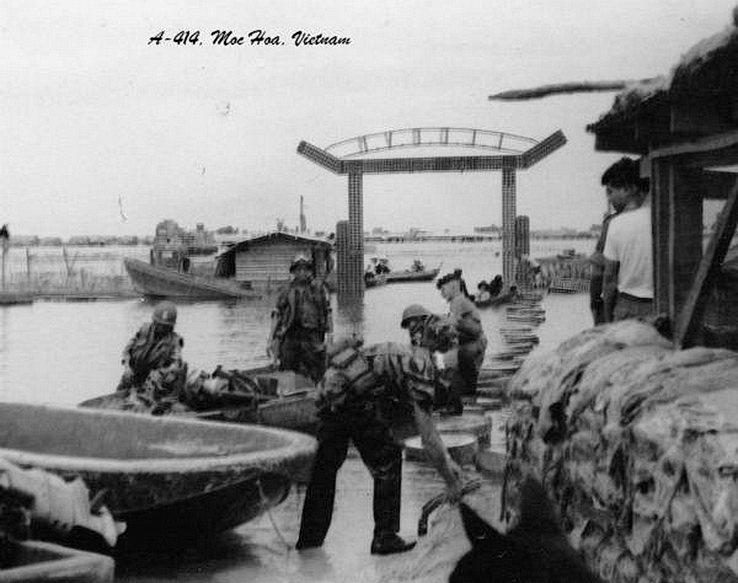
Camp A-414, Moc Hoa (Photo by Wall-of-Faces).
Moc Hoa (A-414) was chosen as the ‘point’ for espionage ‘infiltration’ activities: 3 (CIA) agents ran the plan: Robert Marasco (alias Mike) organized a network of 20 agents operating on both sides of the border: in Mien and in Moc Hoa. Another CIA agent, Alvin Smith (alias Sands), worried about the interpreters working for B-57. B-41 interpreter Tai Khac Chuan, ‘loaned to B-57’ and was found to be a ‘double’ spy set in by CS Intelligence. Chuan was suspected because all B-57 interpreters were killed in the incursions into Mien, except Chuan
On February 19, 1969, Tuyen deliberately let the CQ team that was being ambushed escape, and damaged the radio system, changed the frequency of artillery calls.
Specially discovered due to photos taken during a meeting of the CSBV, the film was confiscated during a SF raid on the CQ secret area inside the Mien land. Specialized was killed in Nha Trang after being exploited by the CIA. The case collapsed, causing ‘noise’ in public opinion. Colonel Rheault (Commander of the 5thSF) was taken to Court and forced to be discharged. Please read more at:
- Some clashes between CIDG and CQ:
- From January 1968, the B-41 organized Operation ‘Snakeman’ in conjunction with the CIDG of the A-412 camps with a Mike Force Company (130 troops +9 SF) to attack and ambush CQ teams in the area around Moc Hoa. canceled many CQ canoes. This operation lasted through April 1968.
- February 2, 1968 : 4:15 a.m. 2 DJs attacked Moc Hoa.. were pushed back, and retaliated with artillery shelling of the B-414’s Barracks. Artillery shells fell outside the fence: Losses on the ARVN side including 3 ARVN, 3 NQ, 4 soldiers, 3 policemen and 7 civilians were killed. 1 NQ, 3 Korean soldiers, 16 ARVN soldiers and 27 civilians were injured. On the CQ side, 136 were killed, 80 bodies were buried when fleeing and 87 weapons were confiscated.
- February 14: CIDG in Binh Thanh village (A-413) intercepted and attacked a Communist Party trooper transporting weapons at 14 km Northwest of Moc Hoa: CQ withdrew leaving behind 17 bodies, 2 were arrested; The confiscated weapons include 1 mortar 60, 1 AK, a PRC 25 machine, 100 mortar rounds of 60, 40 rounds of B-40 ammunition and many other equipment. CIDG has 1 dead, 3 injured.
- On 21 February, B-41 Moc Hoa discovered a cache of CQ weapons just 200 meters from the barracks. collect a large number of mortar shells, recoilless gun ammunition, small gun ammunition and explosives, medical equipment, communications, etc.
- April 17: CIDG discovered a CQ military station in the area near Binh Thanh Village (A-413) destroying an infirmary, cafeteria, and barracks. Confiscated 5 B-44s, 18 B-40s and over 10,000 AK ammunition. KQ then bombed and destroyed the entire area
- April 24: 3 CIDG Companies of A-413 and A-412 surrounded 2 Rd CQ Teams and were caught moving 12 km northwest of Moc Hoa. CIDG has armed helicopter support. After 90 minutes of fighting, the CQ fled: 17 CQ were shot down (14 by helicopter); 2 Chinese machine guns and 4 AK-47s were confiscated; 2 CIDG died, 10 were injured; 2 observation helicopters (LOH) crashed, 2 pilots were injured. One LOH was recovered and one sank in the river.
- On September 1, 1968, a UH-1D of the Royal Thai Army of the 114thAHC (66-16849) crashed inside the Mien border, near Moc Hoa during a CIDG operation, the pilot went missing.
- In 1969: CIDG operations continued in the areas around Moc Hoa, many minor clashes occurred continuously. In a significant battle on October 8, 1969, CIDG coordinated an operation to invade an arsenal guarded by a CQ squadron, near A-415: CiDG had airboats, helicopters and AC-119s to support 15 CQs, capture 5 prisoners; collected 200kg of documents, 209 mortars of 82, 184 mortars, 5500 rounds of SKS rifle ammunition, 200 AK bullets, 17 grenades, 6kg of TNT, collected 7 canoes.
- Navy in Moc Hoa:
The presence of the ARVN Army was noted when HQVN received the HQHK’s Base
- U.S. Navy:
In Moc Hoa, the Military History of HQHK recorded the following activities:
- ATSB (Advance Tactical Support Base) (1968-1971): On the Vam Co Tay River, HQHK has 2 bases of this type: one in Moc Hoa and the other in Tuyen Nhon.
The base was established as an operating station for U.S. PBRs patrolling the Vam Co Tay River during Operation Giant Slingshot built by the HQ Seabees Engineers, and transferred to the ARVN in April 1971.
Colonel HQ R. Schreadley in ‘From the River to the Sea’ recorded the ‘activities’ of HQ staff at ATSB Moc Hoa as follows: ‘.. The river is narrow and winding, the water is always .. pale black like diluted coffee. The base is 3 connected floating bridges, anchored at an angle on the south bank of the river. A gasoline barge gradually anchored along the river, at the end of the Tong Tong range. A helipad reached the North Bank, The movement between the two banks of the river was carried out by small motorboats. On the south bank, the business structures are very limited. enough room for a minivan, an Operations Center and a floating ammunition depot. The outermost pontong is a living place for employees, including a row of wooden houses with 4 layers of sandbags around the wall and also on the roof. In the middle is the dining room and the club… There is an extra large bathroom for 6 people. Pong Tong in the other is the Telecommunications Center and Headquarters. of the US HQ in Moc Hoa.. and is the residence of the SQs. A watchtower is located here, equipped with an M. 60 machine gun and a grenade launcher. Around the base are barbed wire fences. there is a dirt road on the south bank to Moc Hoa but HQ staff are not allowed to leave the camp.
There were about 6 PBRs and a few small battleships anchored at the piers, resting and taking turns patrolling and ambushes.
In April 1969 a team of HQHK Clones was sent to Moc Hoa, participating in some ‘special’ activities inside the land of Mien.
- ARVN Navy:
Operation Slingshot was transferred to the ARVN HQ in May 1970 and the VNA was renamed Operation Tran Hung Dao II
According to Author Tran Anh in “Moc Hoa with People” (www.nuiansongtra.com)
The 64th Patrol Corps (Phase 64TT) is a Vietnamese HQ unit stationed in Moc Hoa
GD64TT went to Moc Hoa to prepare to receive the floating base assigned by the 535th Division of the HK HQ and practice using PBR and getting acquainted with the battlefield while waiting.
This base is connected by 3 barges as barracks and there is an additional oil barge connected. The ARVN received the base around May 1971 and all the equipment consisted of 20 PBR Mark II Peak Tanks and several Spear Peaks.

Phase 64TT is responsible for controlling rivers and canals including the Vam Co Tay river area in Kien Tuong Province to the border of Mien (Svay Rieng Province)
Activities of the Unit: during the day, there are 4 patrol teams: 2 to the North (Vinh Hung, Long Khat) and 2 to the South of Moc Hoa (Kinh 12 and Vam Co River); At night, there were 4 other teams to replace it. It was dark, anchored at the top of the trees to guard the movement of VC until the morning before returning to the Base.
The author further described: “Our HQ base is located on this side of the Moc Hoa river (the section of the Vam Co Tay river flowing through the provincial capital), the width of the river section is as wide as the Ben Nghe river. Across the river is a wide and high B-40 barrier to prevent bullets from coming from across the river.” The rainy season in Moc Hoa was no less difficult, we went to attack at night. What country is the buffalo leech oversized, floating thickly on the surface of the river, as big as a thumb… not to mention mosquitoes and snakes ‘camouflage’.
Director 64TT moved to Tuyen Nhon HQ Base (“the same lonely field located on the Dong Tien canal near the meandering 3rd junction of the Vam Co Tay River”)
Author Doan Quang Vu in the Anthology of Maritime History (page 455) records:
‘ .. In October 1974, Major General Nguyen Khoa Nam held an operational meeting in Moc Hoa Sub-Zone and ordered the 15th Battalion, Moc Hoa Regiment, M-113th Regiment under fire support and transfer of troops of the 214.1st Regiment to take advantage of the floating season to raid directly into the Tam Bien secret area (?) of the CS. After 10 days of marching, our troops were able to enter the logistics of the Communist Party inside the border of Mien (?) ferrying countless supplies of the enemy enough to supply a Communist Army. confiscated the transport vehicle. Molotova. (?). HQ Captain Truong Minh Hoang, Commander of the 64th Army was praised by General Nam for his active support for the Operation.
- Air Force and Moc Hoa:
The ARVN also suffered some losses in Moc Hoa airspace, especially the helicopter squadrons of the 4th KQ. With KQ, Moc Hoa airspace including Kien Tuong Province and planes that may crash in Kien Binh, Tuyen Nhon are recorded in KQ’s articles as Moc Hoa.
List of martyrs of the Armed Forces inscribed: Moc Hoa
(wvw.daltangeve.blogspot.com/2015/10/daan-truth-to-c-kkvh.html)
- 249th Squadron CH-47 Chinook Helicopter
Lieutenant Pham Van Trung and Lieutenant Tran Van Hoa (sic) died in December 1974
- 225 Squadron UH-1 Helicopter
Lieutenant Nguyen Viet Duong, December 74 at My Phuoc Tay, Moc Hoa
(My Phuoc Tay Camp of the LLP in Dinh Tuong Province )
- 110th Squadron Observation
Lieutenant Nguyen Trong De, date unknown, .. Moc Hoa
- 112th Squadron Observation
Lieutenant Tran Duc Vuong and Lieutenant Truong Hiep, 1972, Moc Hoa
Particularly, the losses of Task Force 249 (Mang Long) are most clearly recorded by the author togia9:
- 29-5-1974 : In My An, Moc Hoa. Ship number 143
The crew of 5 people died: Lieutenant Luong Kinh Phuc, Lieutenant Tran Dinh Do…
My An, according to the LLDB, also known as My Da (A-413), is 17 miles from Vinh Long, located in the Tinh Kien Phong where the Southern Sutra and the Governor Loc Sutra meet
On board were BB soldiers and their families.
- 12-12-1974 : In Phuoc Xuyen, Moc Hoa. Ship number 010. Hit SA-7
The crew includes Lieutenant Colonel Pham Van Trung, Deputy Commander, Lieutenant Colonel Tran Van Hoa
- February 9, 1975: At Cai Cai, Moc Hoa. Ship 987 hits SA-7
The crew sacrificed including Lieutenant Nguyen Van Dong, Lieutenant Trinh Nhu Y..
Cai Cai camp according to SF is located on the border of Kien Tuong – Kien Phong; closer to Cao Lanh than Moc Hoa.
The operational mission of Lieutenant Colonel Trung and Lieutenant Colonel Hoa is recorded:
Lieutenant Colonel transferred to Can Tho on December 10, 1974 to receive the position of Squadron Commander of the 249th Battalion (belonging to the 64th Tactical Squadron). On the morning of 12-12-74, Mr. Trung accepted to fly on behalf of Lieutenant Be on a Chinook 010 (the delegation consisted of Colonel Hoa and 3 other employees) The mission to transfer troops from Tan Tich, Cao Lanh to Phuoc Xuyen, Moc Hoa, short route: to and from takes 20 minutes to fly; The transfer of troops is expected to take 4 trips; after the first 3 passes, the fourth was shot down because of the SA-7. Phuoc Xuyen is a Dinh Dien area, located between the south of Moc Hoa and the north of Cai Lay, Dinh Tuong. Military history of the Republic of Vietnam records SN 19010, crash Moc Hoa-SA-7; 50 killed.
- The battles.. from Moc Hoa
Kien Tuong Province was under the responsibility of the 7th BB Division and later the 9th ARVN Division (the 12/7th Army Corps had a light command in Moc Hoa 1969-73)
At the end of 1972, the territory of the 7th BB Division (General Nguyen Khoa Nam) included the provinces of Kien Phong, Kien Tuong, Dinh Tuong and Go Cong. (Confrontation with the ARVN in the area is the 5th and 6th CSBV). Kien Tuong was placed under the command of Special Area 44, then BK 44 was disbanded at the end of 1973; In the reorganization and reorganization of the Army at the end of 1973, the Army units of Region 4 were brought to TTM and the Army Reserve Forces were increased in numbers, especially in Kien Tuong and Go Cong.
30 October 1973 : General Nguyen Khoa Nam replaced General Nghi as Commander of the 4th Army
- Long Khot
Long Khot: in the west of the Crow’s Foot area, only 1 km south of the Mien border and 21 km northeast of Moc Hoa
Summer 1972: Tuoi Tre Newspaper (CS) 28-4-2017 wrote: “In the summer of 1972, after successfully completing the task of liberating Loc Ninh. Troop 147 VC (Cao Bac Lang) was ordered to advance to liberate the Mekong Delta. We thought that we would ‘tidy up’ this small stronghold (Long Khot)… but in fact, due to inadequate research and long-term practice. strange water. so it was a heavy loss. Hundreds and if the whole front and thousands of comrades have fallen between the border river and this Long Khot field..’
There is no record of this battle in the ARVN Military History
- Da Bien Hamlet (Rach Da Bien) 3 October 1973
In the 1973 floating season, the 207th CSBV Corps from Svay Rieng Base crossed the Vam Co Tay river to Moc Hoa, with the intention of attacking Cai Lay (Dinh Tuong). The stop at Rach Da Bien melaleuca forest was detected by the ARVN reconnaissance aircraft and intercepted by the ARVN. The ARVN forces consisted of the 2nd and 3rd Divisions of the 10th Division/7th Army BB, the M113 Detachment, Artillery and Armed Helicopters. CSBV suffered very heavy damage (All 200 students of Hanoi University of Civil Engineering have just entered the South through Nga Mien to supplement the number of troops for this 207th Army, died in battle – Official document of CSBV – People’s Army Newspaper 19-9-2013)) The number of weapons confiscated by the ARVN includes 1 DKZ 75 mm, 1 mortar barrel 60, 3 B-40, 36 AK, 3 PRC-45 machines. On the ARVN side, there was 1 soldier injured. 12 days later, when the ARVN withdrew from the area, they returned to find more bodies of their comrades (40 more bodies were found)
- Tri Phap (12 February – 4 May 1974)
Tri Phap is a swampy area located in the 3 border areas of Kien Phong, Kien Tuong and Dinh Tuong provinces. CQ calls this area Base 470.
Shortly after 28 January 1973, the ARVN planned an operation to prevent the CQ from retaking the area to rebuild the base. This was an operation of the IV Corps (General Nguyen Vinh Nghi) with the participation of many units of the 7BB Army (Tr Đ 12), the 9BB Army (Tr Đ 14), the Cavalry (TH Corps 2 KB), the Army and local units of the relevant provinces. Z-15) from Svay Rieng. Particularly in Kien Tuong, many clashes occurred in February 1974 and the Dong Thap 1 Youth Union of the CSBV was severely damaged.
The ARVN held the Tri Phap area after inflicting very heavy losses on the CSBV, about 1100 soldiers were killed, 600 weapons of all kinds were confiscated, and over 5,000 tons of rice were confiscated.
- Moc Hoa in the Svayrieng operation
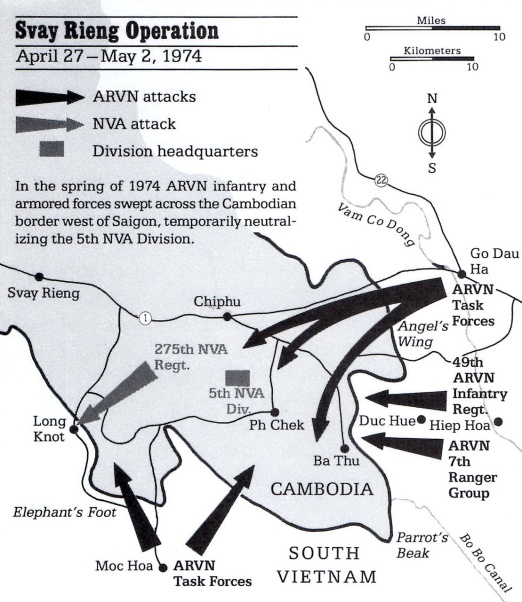
Projection of the 1974 Svay Rieng expedition by The Vietnam Experinece.
This was a coordinated operation between the 2 3rd and 4th Corps of the ARVN, crossing the Mien border to attack the Parrot Mine Area. A branch of the Parrot’s Beak that crashed into the Elephant’s Foot Branch was called the Elephant’s Leg Branch. While the 3rd Army attacked Mien from the North. then the CQ in the Svayrieng area responded by attacking Long Khot
On 28 April, the 275th Army reinforced the 25th Commando Group and the M-113 (captured by the ARVN) to attack Long Khot. The local forces of the ARVN held their positions thanks to the support of over 100 airships. The ARVN defeated 75 Cong Army, captured the CS artillery team (including gunners of all types 122, 105, AT-3 and SA-7..)
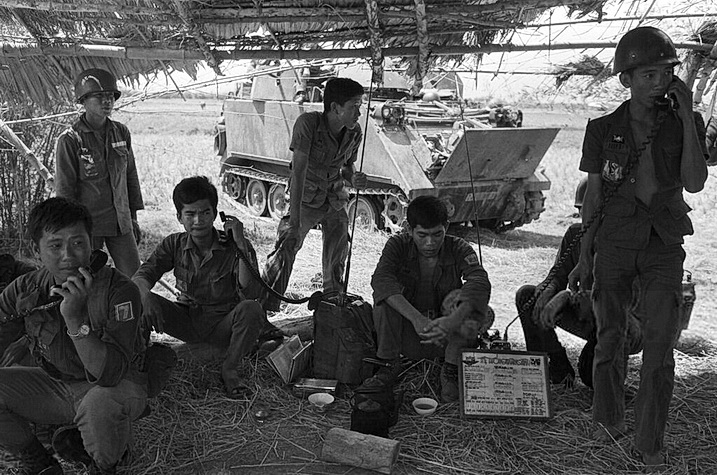
Officers of a unit of the 7th Infantry Division during an operation (Photo by LAURENT MICHE).
The 7th BB Division sent the troops to relieve the troops, using 2 wings: 1 by the 15th Division/9th Division supported by the 16th Division and one by the 10th Division/7th Division reinforced by a number of units of the 6th Division. After 12 days of clashes, the CQ was repulsed: 850 soldiers were killed, 31 were captured, 100 weapons were confiscated. the ARVN side had 39 casualties, 300 wounded.
(Xin đọc thêm ‘ ‘VietNam from Cease-Fire to Capitulation’ của LeGro)
- Moc Hoa.. The last days of the war:
From the end of 1974, the Communist Party prepared for the General Offensive: in December 1974, the Communist Party organized an additional 8th Army from the invading Army to operate in Kien Tuong Province and launched strong attacks on the Long Khot and Tri Phap areas, uprooting all the Communist Party and the lone Insurgent Army.
The heaviest clash took place at the end of January 75: VNCh only held 2 outposts in Tuyen Binh: Long Khot was repeatedly attacked and surrounded by CQ units of the 6th and 174th Divisions.
From 1973-74: Kien Tuong became the first province of the Western fire line: Moc Hoa was often harassed by shelling
The 9th BB Division had a Light Command located in Moc Hoa, with a limited number of troops and only ‘representative’ officers. This command became more important from 1974. Commander of the Army, General Huynh Van Lac is often present and stays here.
In mid-April 1975, the Light Command at Moc Hoa moved to My Tho
On May 26, 1975, the 147th CSBV Regiment crossed the border of Svay Rieng to attack Long Khot (Fallen Sub-Area) intending to encroach on Moc Hoa but then changed its plan and moved back to Long An, cutting off National Highway 4 to encircle SaiGon (while Moc Hoa Sub-area had prepared defenses and prevented the shelling of CQ.)
The last Governor and Sub-district Chief (1973-75): Colonel Nguyen Van Huy handed over the Government to the CS after consulting with General Nam. (Please read Memoirs: Moc Hoa Once the Battle of Trinh Xuyen (https://vantuyen.net/2015/02/27)
Tran Ly (5-2020)
Note: The scope of this article only records some military activities in Moc Hoa. In Kien Tuong, there is also Tuyen Nhon Naval Base where many other important battles took place. We will continue to write in the article “Tuyen Nhon” In addition, Moc Hoa – Tuyen Nhon are located on the Vam Co Tay branch. The Vam Co Dong branch is also quite important in the Military History of the Republic of Vietnam.
- In the program of converting CIDGs in Kien Tuong Province into the Land Authority
– Thanh Tri, 315 CIDG was converted into 67 Border Guard Unit(31-8-70)
– Binh Thanh Village: 332 CIDG into TD 86 BP Board (31-10-70)
– Tuyen Nhon: 302 CIDG into 75 BP Board of Directors (30-9-70)
– Cai Cai: 396 CIDG became 76 BP Board of Directors (2-10-1970)
These 4 TDs were merged into the 41st Border Guard Task Force (1970)
Later: 1972-75, 2 TDs 67 and 76 became LD 25 BD (with the addition of TD 90)
Nguồn: https://dconnect.co.jp/friend/tranly/
For more information visit my website: ptaylorvietnamadvisor.com
The Advisor Series:
- “The Advisor, Kien Bing, South Vietnam, 1969-1970. A Novel” (Available on Amazon ASIN: B09L4X5NQ3)
- “The Province Senior Intelligence Advisor, Kien Song Province 1970-1971; A Novel” (Available on Amazon ASIN: B0BHL2XCX5)
- “The Hardchargers,” Vietnam 1972-1973; A Novel” (Available on Amazon ASIN: B0C7SPR1JY)
- “The Tuscarora Trail” (Available on Amazon ASIN: B0D3QY2GM6)
Check out my website for other books that I’ve written or edited.
Website: ptaylorvietnamadvisor.com
 Peter A. Taylor's Home Page
Leave a comment