
During my first assignment in Vietnam I was assigned to the Phoenix Program or Phụng Hoàng in Vietnamese. The program was very controversial especially during the early days of the war when it was run by the Central Intelligence Agency and the Special Forces teams. By the time I arrived the CIA and the Special Forces (SF) teams we’re out of the picture. The majority of the SF teams had returned to the states or were in the process of transferring their mission to the Military Assistance Command Vietnam MAC-V. I also had the privilege of working with some Australian officers who were also involved in the Phoenix Program in the southwestern part of the Mekong delta near the town of Vũng Tàu, as well as some South Korean officers who were operating in the Saigon area.
The nation of South Vietnam was administratively divided into 44 Provinces. Each province was subdivided into districts, I believe that were 256 districts. The country was also subdivided into four large Corps areas for military operations. IV Corps, where I operated during my first assignment, consisted of the area composing the Mekong Delta. Each Corps area was commanded by a general officer. Each province had a MACV Team with a set of advisors commanded by a Colonel or a senior Lieutenant Colonel. Each district had it’s own Advisory team usually commanded by a Captain or a Major (depended on the size of the district team).
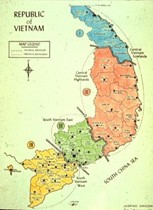
Kien Tuong Province is the Northwestern Province in IV Corps along the Cambodian border and the border with III Corps.
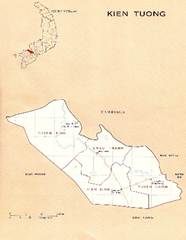
Kien Tuong Province (1969-1975)
By the time that I arrived, completed my training, and was sent to the field the CIA had been phased out of the Phoenix operation. It had been turned over to the Civil Operations and Revolutionary Development Support command (CORDS) which was controlled in the Mekong Delta by my mentor John Paul Vann.
Our mission was to identify and destroy the Việt Cộng Infrastructure in my district and provincial areas. This was a counterterrorism/counterinsurgency program, and it involved us attempting to capture and interrogate members of the political infrastructure that supported the Việt Cộng and North Vietnamese operating in our area. The purpose of our mission was to separate the local Vietnamese citizens from the communist insurgents who were trying to infiltrate through our area. However there was also a very deep political structure that developed and that was referred to as the Việt Cộng Infrastructure or ‘VCI’ for short.
The VCI was a simple organization. Virtually every village had a cell made up of a Communist Party secretary; a finance and supply unit; and information and culture, social welfare, and proselytizing sections to gain recruits from among the civilian population. They answered up a chain of command, with village cadre answering to the district, then to the province, and finally to a series of regional commands which, in turn, took orders from Hanoi.” In most cases in our area a village cell might only contain one or two individuals in each of these positions. But they were prepared to take over their specific function if and when the government in Saigon collapsed. In two of our villages the VCI Village Chief also commanded the Việt Cộng guerilla operations. Cells were secretive and in some cases only the Việt Cộng Village Chief knew all of his assets.
Our mission was to sort these people out and bring them to trial or ‘neutralize’ them. According to the law, before we could arrest anyone we had to have three separate reports that the individual was supporting the communist regime. Our Chief of Police would develop a dossier on an individual and we would build reports on that individual. Once we had the necessary number of reports we would send a police team out to arrest them. If sufficient evidence was available through interrogation and through reports the individual ultimately could be sent to Saigon for trial.
One of the difficult parts of gathering information of this kind was sorting out real information from grievances and personal vendettas that occurred in these small villages. As I mentioned it took three ‘positive’ dossier entries before the police could begin an investigation. The difficulty was to sort these out and determine fact from fiction.
If your rival businessman was feeling the weight of the competition he might go to his friends and have them report his rival to the local police officer who would begin the investigation. This could cause the rival to spend time defending themselves. We ran into one case where a woman was trying to get out of an arranged marriage, and she had her relatives report her husband as a Việt Cộng operative to get him arrested and sent to Saigon for interrogation. The local village police officer realized what was happening and reported it to the District Police Chief and the case was dropped.
Of course there were also high level members of the VCI who were assassinated or killed when we were trying to capture them. In our case these missions were all conducted by the South Vietnamese and by the time I arrived at Ap Bac I had no direct involvement in the actual operations. The South Vietnamese government looked at this as a police action rather than a military action.
As I mentioned in another blog, getting the Vietnamese to cooperate with one another was a very difficult task. One of the organizations that was established to assist in this coordination was called the District Intelligence Operations Coordinating Center (DIOCC). The DIOCC’s mission was to establish an office where all of the various intelligence assets were stationed together. In my DIOCC we had an office for the police chief, an office for the S-2 intelligence officer, the Rural Development Office was located there, and the Chiêu Hồi (Open Arms) program’s offices. The Chiêu Hồi program was developed to induce members of the NVA and Việt Cộng to defect or surrender.
In concept, the idea was to put all of these agencies together so that they would cooperate and share intelligence. That way we could put together a dossier and identify, locate, and neutralize any members of the Việt Cộng infrastructure. Each of these agencies had intelligence gathering capabilities and the idea was that if they shared intelligence they could improve operational capabilities.
It was a very good idea to establish the DIOCC, but the reality was getting the various agencies to share intelligence was very difficult. Each one of the organizations felt that somehow the other agencies were compromised. They were often afraid to share intelligence for fear that either their own agents might be compromised or their methods of collecting information might be discovered. They just would not trust one another. As a result it took a lot of work as an advisor to resolve this trust issue.
When I first got there I had a very difficult time dealing with the Chief of Police and the district’s intelligence officer. There was a lot of bad blood between the two of them and I don’t think they really liked one another. They certainly didn’t trust one another! I developed a very good individual relationship with both of them, but when I tried to work with the two of them together that was another story. Neither one ever really trusted the other. There was another issue and that was that the military always seem to be in control. The Chief of Police felt left out in many cases.
This created a very unique situation as a part of the Vietnamese culture. He always felt that he never got the recognition that he should have received for his actions. The S-2 felt that the Police Chief was a corrupt agent. He was unwilling to share any of the recognition that was received during a military operation.
The military was in a unique situation where they couldn’t arrest a known VCI agent, a civilian, without the police present. As a result in some cases suspected VCI agents were killed in the military action rather than being captured and interrogated. In some cases I’m certain that field interrogations were held and that there were some possibilities of actual executions or assassinations. The military would classify the individual killed as a Việt Cộng guerilla and that would be the end of the discussion. Just another ‘bad guy’ killed in action.
If a police officer was present they had the authority to arrest and hopefully the VCI agent would be brought back for further interrogation and a potential trial. To this day I really don’t know how many people who were identified as communist agents were killed and reported as members of the Việt Cộng military forces. The problem was getting the Chief of Police to send one of his officers out on the military patrols.
I also had reports of police officers arresting people and bringing them back to the district headquarters at Ap Bac and interrogating them on site. Most of these individuals were usually released with a warning that they were developing a dossier on them. I’m also certain that there was some graft and corruption going on with these arrests. But it was difficult to prove that.
The Phoenix program was very successful at suppressing the Việt Cộng Infrastructure. By the time I left my district cooperation between the military and police and other agencies had improved significantly. Chapter 18 of my book, “The Advisor” describes a major operation that we were able to conduct in coordination with the police and the military together. The raid was a very successful operation and resulted in our destruction of a major black-market money-laundering and smuggling operation. This operation was smuggling hard currency out of South Vietnam along the Hồ Chí Minh trail and up to Hanoi. Each of my counterparts received recognition at the same time during a major award ceremony. As a result of this sharing of recognition they tended to work closer together for the rest of the time that I was there.
At the district level once a suspect was taken into custody they would be sent to the provincial headquarters where they would be processed and interrogated. The information that was obtained during these interrogations was used to identify other members of the communist cells operating in the area. This information would be then be turned over to the military (military targets) or the police (civilian targets) and we would react to try to capture or eliminate or ‘neutralize’, as the buzzword was, additional suspects.
The stated intent of the Phoenix program was too “attack the VC with a rifle shot rather than a shotgun. It emphasized targeting key political leaders command and control centers and activist in the VCI Infrastructure.”
At my training course in Vũng Tàu we had the opportunity to meet General Creighton Abrams who commanded the Military Assistance Command – Vietnam. He told us that he wanted us to avoid heavy-handed operations against the general Vietnamese population. It had a negative effect on the civilian population and the intelligence that was derived during these activities generally wasn’t very good.
It was estimated that 87% of those killed during Phoenix operations were actually killed in conventional military situations.
How effective was the program? According to the government of Hanoi they felt it was one of the most effective programs that was developed in the war that was used against them. By the time I arrived the entire VCI structure within my district was well identified. We actually had photographs of the vast majority of the suspects that we were looking for. Many of them had escaped to Cambodia after the TET Offensive.
The TET Offensive was devastating to the VCI. They were certain that they were going to win and as a result they actually identified themselves and came forward. When the North Vietnamese forces were destroyed in my area many of the VCI fled to Cambodia to avoid capture.
While there were still some VCI active in my province and district in 1969 and 1970 they were actually very low level operatives. The senior operatives had either escaped to Cambodia or by going to Base Area 470 in the southern end of the district. The Base Area was a heavily defended portion of the district that was rigidly controlled by the Việt Cộng. It contained a large number of bunker systems and support facilities for military operations. It had it’s roots back to the Việt Minh resistance to the French in the 1940-1950’s.
As a result of this dispersion, the VCI had lost their influence on most of the local civilian population. That was one of the goals of the pacification program. When we raided the base area in 1971 we nearly destroyed the entire VC I operations in our district and in some cases large parts of our province.
The Việt Cộng saw the Phoenix Program as a significant threat to the viability of their revolution because, to the extent that you could carve out the shadow government, their means of control over the civilian population was dealt a death blow. Even in their own assessments after the war they felt that the Phoenix program had been one of the most effective tools that the South Vietnamese government had used.
The Phoenix program was so effective that when the war ended in 1975 the government sought out anyone who had been involved in the Phoenix program for special treatment. Many were executed or sent to reeducation camps where they received ‘special treatment’. It is said that many of the people who were involved in the Phoenix program ‘disappeared’.
All in all, I think the operation of the Phoenix program in our district ultimately was very successful. By the time I left the majority of the individuals who had been identified as members of the VCI were identified, arrested, or intimidated into changing sides to support the government in Saigon.
The Vietnamese loved to have their photograph taken. By the time I left the district our chief of police had raided the small photography shops in the district, and we had photographs of almost 85-90% of the known VCI and guerillas operating in the district. These photographs were incorporated into their dossiers, making it easier to identify suspects who were captured.
While I am certain that there were probably some very ‘harsh’ interrogations that occurred in the field, I never observed a violation of the Geneva Accords as far as the treatment of prisoners was concerned during my time at Ap Bac or Moc Hoa. I believe that my counterparts understood that I had to report such violations up the chain of command if I observed them. Therefore they made sure that I was never present when such types of interrogations were conducted.
Next week I’ll discuss the Chiêu Hồi program and how it worked at my level.
If you’ve enjoyed my Blog entry, please leave a comment. If you are a fellow Vietnam Veteran, Welcome Home My Brother and Sister! We Made It! If you are enjoying these blog entries or have any questions or comments, please drop me a message or an email. If you do purchase any of my books let me know how you liked them. Thanks! Pete “Hardcharger” Taylor.
If you’re enjoying these blogs please drop me a comment or if you have any questions that I might answer, again submit a comment on the comment pages. I’m always glad to hear from you.
Again, please take a look at all of my books that I have listed. They can be purchased from Amazon.com with the click of a button directly from the website. Until Friday, Have a good one.
The Advisor Series:
- “The Advisor, Kien Bing, South Vietnam, 1969-1970. A Novel” (Available on Amazon ASIN: B09L4X5NQ3)
- “The Province Senior Intelligence Advisor, Kien Song Province 1970-1971; A Novel” (Available on Amazon ASIN: B0BHL2XCX5)
- “The Hardchargers,” Vietnam 1972-1973; A Novel” (Available on Amazon ASIN: B0C7SPR1JY)
- “The Tuscarora Trail”(Available on Amazon ASIN: B0D3QY2GM6)
Check out my website for other books that I’ve written or edited.
For more information visit my website: ptaylorvietnamadvisor.com
 Peter A. Taylor's Home Page
Leave a comment