In my books I often describe some of the issues in dealing with our Vietnamese counterparts.
As American Advisors we faced a philosophical and cultural difference with many of the Vietnamese that we dealt with. As westerners or Americans tend to think in concepts such as “never put off until tomorrow what should be done today!”; or “carpe diem”; seize the day! Opportunity only strikes once so grab it!
Our military training is action oriented. As my Sergeant used to tell me “Do something Lieutenant, even if it’s wrong! We can always correct it if it’s wrong, but we can’t correct hesitation or inaction!”
Some of our Vietnamese counterparts found those concepts to be very confusing and potentially offensive. Their ideas on life were more of a chessboard where they would try to contemplate what their opponent was going to do, not necessarily today, but in the future. They would then try to develop their concepts based on what they anticipated rather than what they could immediately develop. Their fear was that they might do something wrong that would cause embarrassment or ridicule. Caution was more important than that action.
On our part we often viewed these concepts as cowardly, inept or indifferent to progress. Often, we would view this reluctance as accommodating the enemy.
Many of our counterparts had a difficult time in dealing with our concept for immediate action. They believed that life was as circle and if something didn’t happen today the event would reoccur in the future; it could be dealt with at another time;” never act today because opportunity will re-present itself in the future and the results will be the same!”
Another ‘strange’ concept that we had to deal with was the idea of ‘saving face’. This is a concept that means something different to most westerners.
Saving Face is a concept or a strategy that is developed to, “avoid humiliation or embarrassment, to maintain dignity or preserve reputation”. There is a significant importance in maintaining social harmony and avoiding embarrassment or ridicule. To criticize someone in public could or would be seen as a “loss of face”. Often a subordinate’s idea couldn’t be directly adopted by someone senior, because “I should have thought of that!” Loss of face not only effected the individual but could bring shame on the entire family.
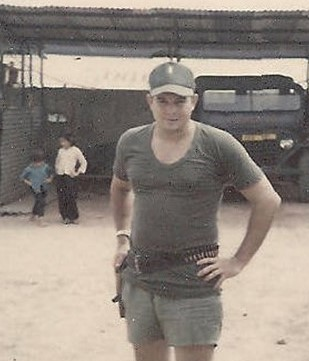
Now couple all of this with the concept of being an advisor in the military. Remember that I was a very junior officer, a newly commissioned second lieutenant, and a very young and inexperienced officer (20-21 years old) at that. I was expected to offer advice and assistance to officers and government officials who are expected to have a greater degree of maturity, knowledge and experience. It wasn’t just me either.
One of my first meetings with Captain Pete Wetherell, our District Senior Advisor, dealt with my situation. He explained to me that in most cases the Vietnamese that I would be dealing with would have absolutely no desire to listen to me, unless they wanted something tangible. He warned me that I shouldn’t expect any immediate results from my suggestions.
“Now Taylor, just remember your place in their society. You are a snotty nosed kid who knows nothing! No Vietnamese officer is going to ‘obey’ your orders! If you want to be successful out here, you have to convince them that they have a good idea and that you’ll provide any support that they might need.
For you to be successful you’ll need to make suggestions to them, and for your sake just remember that they’ll listen to you and seemingly ignore your ‘advice’. Two days later they will have this ‘wonderful idea’ and it will be exactly what you suggested two days ago. For God’s sake don’t ever tell them ‘I told you so’!
Compliment them on their wise decision and then ask them, “that’s a great idea, but have you considered…” to clarify their concept and offer additional advice. But remember at all times it has to be their idea and final concept.”
Pete was right. In my dealing with my counterparts, I had to take a very careful approach. It was difficult! I could see times when we needed to act immediately. Being young and energetic I often had a difficult time not imposing myself into their decisions. However, for me to have a better idea than theirs could cause them to ‘lose face’ or military prestige.
In my story about my ‘wounding’ at ‘Tram Key Stream’ (see Chapter 15) I emphasize the fact that the Vietnamese Captain was very adamant that HE was in Command and not ME! He ‘appreciated our support’ but it was his operation and not mine. He didn’t follow the plan that had been laid out and as a result the plan failed, men were killed and wounded, and he had to do to something to ‘save face’. When he couldn’t ‘save face’ himself the District Chief bailed him out to save his military dignity by rewarding him with a Vietnamese Cross of Gallantry for his ‘actions’ and exaggerated his accomplishments. Both the Captain and his boss ‘saved face’; the captain because he could point to his new medal; the District Chief because his subordinate, while blowing the operation, was recognized for his ‘heroic’ action.
A significant aspect of this ‘saving face’ was our difficulty in getting intelligence organizations to cooperate. We had established the DIOCC/PIOCC (District/Province Intelligence Operations Coordinating Center) concept with an idea of centralizing the collection, analysis and coordination of the intelligence at one central location. It was a great concept ‘on paper’ but getting it to actually work was something else.
In “The Advisor” you can see the struggles that I faced at Ap Bac in trying to unify the intelligence efforts. There were a number of agencies involved and each of them had a hand in developing intelligence.
First and foremost, for me was the Military Intelligence aspect. The District S-2 Intelligence Staff Officer (‘Phoung Hai’) was responsible for developing combat intelligence for the district and providing it to the District Chief (I’ll talk about him later) for day-to-day intelligence operations. But he was only one of the key players in the intelligence game.
The Chief of Police (‘Cahn Sat’) was also involved with the collection of intelligence, primarily on the VCI or Việt Cộng Infrastructure. (I’ll talk about the Việt Cộng Infrastructure and the Phụng Hoàng (Phoenix) in another Blog). But often his intelligence could benefit the S-2’s information.
There were other agencies that were also involved that collected intelligence or gathered information that could be used in the intelligence business. These included the Rural Development Agencies, the Office of Resettlement and Chiêu Hồi program (again more in another blog post).
The problem was that none of these organizations wanted to cooperate with one another. They felt that if they shared information that somehow their status would be assumed by the other agency. If the Chief of Police passed a report to the S-2 for action it would be the S-2 that ultimately gained the favor of the District Chief and not the Chief of Police. There was also the concept that the information that was gathered by an outside agency couldn’t be trusted or verified so it probably wasn’t valid.
There was always the ‘fear’ that the other agencies had been compromised and that they had informants operating in the other organizations (of course there weren’t any Việt Cộng informants in their system, just the other guy’s!) if they shared information, they might potentially be revealing their source of information or collection method to the enemy. Remember that in the intelligence ‘game’ the two most sacred pieces are the source of the information and the method of collection. WHO gave up the information; HOW did it get uncovered and HOW did it get to the collecting agency.
Often a number of agencies were unknowingly using the same individual for intelligence collection and this led to a significant problem in analysis of intelligence.
Agent “A” might be providing the S-2, the Police Chief, the Navy Intelligence Officer, and the Special Forces ‘Mike Force” with information at the same time. If agencies didn’t accredit the agent, it led to a piece of information being considered extremely accurate because it was coming from a variety of sources. In reality it was the same story told numerous times making it appear to be valid. The agent was getting paid by all of the agencies that he/she was reporting to, so they didn’t care.
As an advisor these was a particularly difficult situations that had to be navigated.
My major success was getting the Chief of Police and the S-2 to cooperate with one another on “The Raid” (see Chapter 18). It was a difficult challenge, but we managed to successfully pull it off.
Initially, when I arrived, the two of them had little direct contact and there was a significant degree of animosity between the two of them. Getting the two of them to work together and share operational intelligence took a lot of effort on my part. But we managed to get them to cooperate and develop an operational concept together where they both shared responsibility and, in the end, shared in the ‘glory’ of the final accomplishment. As a result, they began to develop a cooperative effort that was significant and improved our District’s operations.
Then there was the District Chief!
Our first District Chief was an absolute crook. I was told later, on my final tour in Vietnam, that when I shook his hand, I should carefully count my fingers to make sure he hadn’t stolen one of them!
The Vietnamese Captain was a political appointee. His father was a general in the Vietnamese Army and assigned to the senior military staff in Saigon. His son was appointed as the District Chief of Kien Binh because it was a relatively safe district from a military standpoint. The local Cao Đài militia had destroyed the North Vietnamese regulars and the Việt Cộng (See Chapter 7) during the Tet Offensive in 1968 and afterwards the district was relatively quiet.
The district also was a rich agricultural area and as a result there was a lot of potential for graft and corruption on the part of a District Chief. The District Chief also controlled a military force that he could use to enforce his corruption and intimidate the civilian population. Rumor also had it that the Việt Cộng and NVA were bribing him to not interfere with their infiltration routes that came through the district.
He tried to ‘shake down’ the Military Assistance Command when we moved into the district offices. He kept delaying the move and insisting on additional funds to make accommodations for the MACV Advisors. When we did finally move into the District Headquarters building there was an unwritten rule about ensuring that he had his personal supply of alcohol and beer provided by the team.
The captain was married with children in Saigon. However, his ‘niece’ resided with him at Ap Bac. Of course, his ‘niece’ was actually his live-in mistress.
He was also ‘ghosting’ the number of troops on hand and getting paid. He would inflate the number of soldiers under his command and then abscond with the pay for these ‘ghosts’. He might report 100 soldiers for pay to Saigon yet only have 45-50 physically on the rolls. He would then pocket the pay that was sent to pay the troops that only existed on paper. It was a great gig if you could get it!
My direct counterparts, the Chief of Police and the S-2 had no desire to be stationed at a ‘backwater’ like Ap Bac. Both had irritated a superior somewhere down the line and had been relegated to serve at Ap Bac as a result. I found this to be the case even at the provincial capital when I moved up there in 1970. Even our Catholic priest had been relegated to serve a huge parish area because he had crossed a bishop in Saigon.
While many of our counterparts were probably second-rate, they generally did their job. My S-2 counterpart reminded me one time that he had had many American Advisors during the war. They all went home, but he and the rest of the Vietnamese stayed. Basically, he was telling me that as much as I’d like to change things that things would remain the same.
In another blog I’ll discuss Lieutenant Colonel Tua, perhaps one of the finest military officers I’ve ever served with. Trung tá Tua deserves his own blog entry.
If you’re enjoying these blogs please drop me a comment or if you have any questions that I might answer, again submit a comment on the comment pages. I’m always glad to hear from you.
Again, please take a look at all of my books that I have listed. They can be purchased from Amazon.com with the click of a button directly from the website. Until Friday, Have a good one.
The Advisor Series:
- “The Advisor, Kien Bing, South Vietnam, 1969-1970. A Novel” (Available on Amazon ASIN: B09L4X5NQ3)
- “The Province Senior Intelligence Advisor, Kien Song Province 1970-1971; A Novel” (Available on Amazon ASIN: B0BHL2XCX5)
- “The Hardchargers,” Vietnam 1972-1973; A Novel” (Available on Amazon ASIN: B0C7SPR1JY)
- “The Tuscarora Trail”(Available on Amazon ASIN: B0D3QY2GM6)
Check out my website for other books that I’ve written or edited.
For more information visit my website: ptaylorvietnamadvisor.com
 Peter A. Taylor's Home Page
Leave a comment